
Air quality
The Zurich Airport Group is a global leader in measuring and modelling air pollutants and implements measures on an ongoing basis to reduce the volume of air pollutants emitted.
Relevance
Operation of the airport and, in particular, the aircraft releases pollutants into the air. A distinction can be made between four sources: aircraft, handling operations, airport infrastructure and land-side traffic. Pollutants are primarily produced by the combustion of fuels such as kerosene, natural gas, heating oil, diesel or petrol. In addition, particulate matter is produced by tyre abrasion. Aircraft engines account for the majority of emissions. The following pollutants are particularly relevant: nitrogen oxides (NOX), particulate matter (PM), volatile organic compounds (VOC) and carbon monoxide (CO).
Air pollution can be viewed from two different perspectives: firstly the quantity emitted at source (emissions), and secondly the quantity measured at a specific location (pollution exposure). A complex interrelationship exists between emissions and pollution exposure. Once discharged into the atmosphere, emissions do not remain in the same state – their composition changes, and they are diluted and dispersed before actively becoming pollutants together with emissions from other sources.
Ensuring information is transparent and complete is important to Zurich Airport Ltd. It provides comprehensive information about the air pollution situation at the Zurich site and takes steps to minimise its impact on the environment as far as possible.
Approach
Official annual nitrogen oxide emission limits are specified for Zurich Airport. To document compliance, Zurich Airport Ltd. maintains an emissions inventory that records how much of each individual pollutant is emitted annually. The company must also comply with emission limits specified for individual emission sources such as vehicles or heating furnaces.
The pollution exposures, for which limits also exist, are modelled extensively using specialised computer programs and measured concurrently at specific locations. A fully automatic measuring station is installed at a central location at the airport to record several pollutants. In addition, passive collectors are used to measure the indicator pollutant nitrogen dioxide. Since Dock A, where the monitoring station is set up, is being rebuilt, the station will need to be relocated in the medium term. Additional passive collectors were installed this year in order to find suitable new sites with similar conditions.
Zurich Airport Ltd. achieves its goal of keeping air pollutant emissions as low as possible at the Zurich site by taking action on all four sources mentioned. The measures taken affect the entire airport system and thus also the partners at the airport. Emission-based landing charges have been levied for years in an effort to reduce aircraft pollutant emissions. Lower-emission aircraft pay less, which makes it worthwhile for airlines to use appropriate aircraft. Another important measure is the installation of stationary systems to supply electricity and air conditioning at all aircraft parking stands in Zurich, Florianópolis, Vitória, Natal and Iquique. Using these systems results in far lower pollutant emissions and also reduces noise and CO2 emissions compared to when aircraft use their own auxiliary power units for the same purpose (see Net zero roadmap). Operational processes have also been established that help minimise the amount of time aircraft spend queueing with their engines running.
In ground handling, the gradual transition from internal combustion engines to electric drives is in full swing for vehicles and machinery, not only at Zurich Airport Ltd., but also at its partners.
Where infrastructure is concerned, new and renovated buildings plus operational optimisation are helping to reduce the demand for fossil-based heating and consequently lower pollutant emissions at Zurich Airport.
Finally, when it comes to land-side transport, the company participates in measures to make public transport more attractive for employees, passengers and visitors alike for travel to and from the airport. This includes promoting more and earlier train connections in the early hours of the morning for employees who work shifts and for passengers with early departures.
Situation in the reporting year
The emission levels of nitrogen oxides (NOX), the indicator pollutant, have increased again at the Zurich site. This is attributable to the rising number of flights and the fact that on average, heavier aircraft with correspondingly higher pollutant emissions have been used. The emission values of the same pollutant also increased compared to the previous year and are only slightly below the threshold value. This was partly attributable to meteorological conditions, which were less favourable than in the previous year. The weather at the end of the year, in particular, was characterised by stable inversion conditions that hampered mixing of the air layers. This kept the pollutant’s concentration on the ground at a high level.
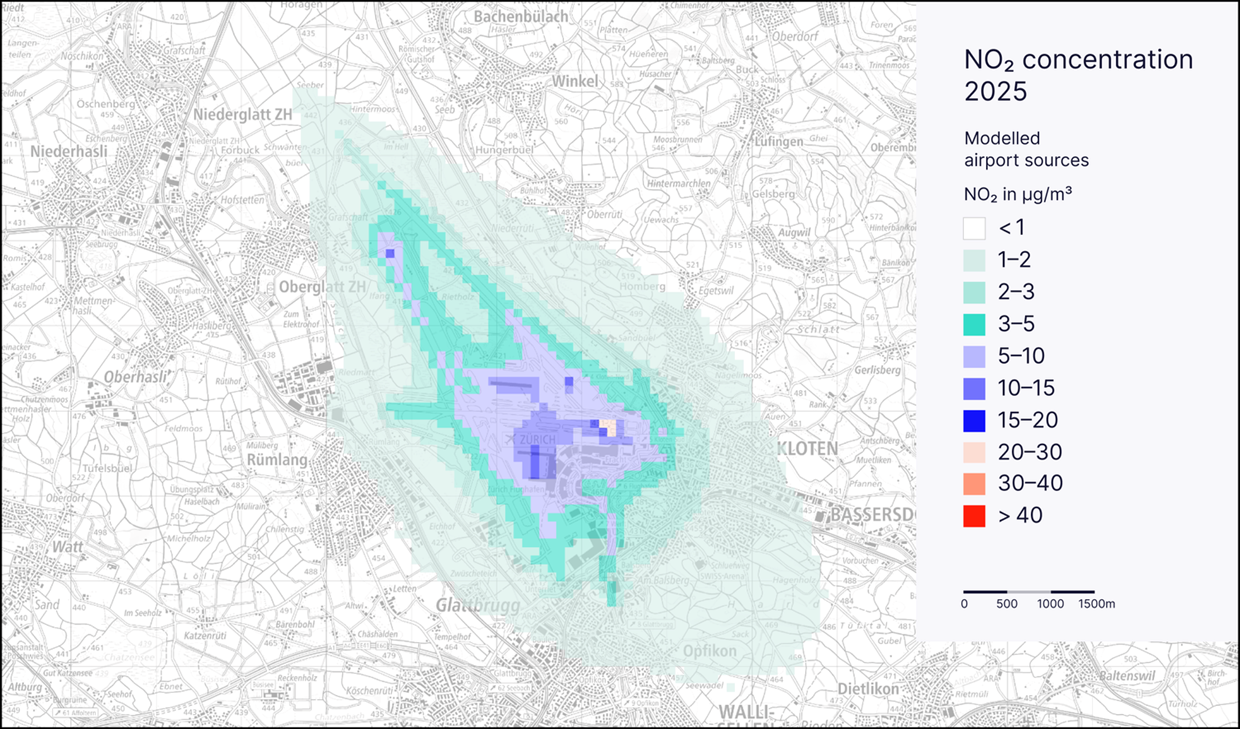
Zurich Airport’s contribution to nitrogen dioxide pollution in the region
Monitoring of air pollution continued in Noida, India, where construction was well under way, during the reporting year. Periodic measurements were made at several locations. The values were below the local limits for all pollutants recorded (including NO2, PM, CO and SO2).
In Brazil, air quality measurement for airports is not mandatory. However, the sites in Brazil periodically conduct measurement campaigns for individual air pollutants.
Key data
Air quality
Zurich Airport, Switzerland | Unit | 2021 | 2022 | 2023 | 2024 | 2025 | ||||||
NOx emissions | Tonnes | 611 | 1,005 | 1,184 | 1,249 | 1,415 | ||||||
of which from aircraft1 | Tonnes | 539 | 929 | 1,098 | 1,169 | 1,336 | ||||||
of which from ground handling | Tonnes | 22 | 32 | 31 | 28 | 24 | ||||||
of which from infrastructure | Tonnes | 39 | 32 | 41 | 38 | 41 | ||||||
of which from landside traffic | Tonnes | 11 | 12 | 13 | 15 | 14 | ||||||
VOC emissions | Tonnes | 129 | 176 | 197 | 207 | 228 | ||||||
of which from aircraft1 | Tonnes | 88 | 131 | 149 | 157 | 176 | ||||||
of which from ground handling | Tonnes | 9 | 14 | 16 | 17 | 18 | ||||||
of which from infrastructure | Tonnes | 27 | 25 | 24 | 25 | 26 | ||||||
of which from landside traffic | Tonnes | 5 | 7 | 8 | 8 | 7 | ||||||
CO emissions | Tonnes | 568 | 881 | 1,012 | 1,060 | 1,106 | ||||||
of which from aircraft1 | Tonnes | 512 | 816 | 935 | 985 | 1,028 | ||||||
of which from ground handling | Tonnes | 12 | 17 | 19 | 18 | 15 | ||||||
of which from infrastructure | Tonnes | 15 | 12 | 14 | 17 | 22 | ||||||
of which from landside traffic | Tonnes | 29 | 36 | 43 | 40 | 40 | ||||||
PM emissions | Tonnes | 10 | 14 | 16 | 16 | 17 | ||||||
of which from aircraft1 | Tonnes | 7 | 11 | 13 | 14 | 16 | ||||||
of which from ground handling | Tonnes | 1 | 2 | 2 | 1 | 1 | ||||||
of which from infrastructure | Tonnes | 2 | 1 | 1 | 1 | 1 | ||||||
of which from landside traffic | Tonnes | 0 | 0 | 0 | 0 | 0 |
1Flight operations in LTO cycle (up to 915 m), taking into account actual engine power, APU, engine start-up and airframe.
Sum totals may contain slight discrepancies due to rounding.
