
Our contribution to the attainment of the Sustainable Development Goals
With the 2030 Agenda, the United Nations (UN) has defined a global reference framework for sustainable development. It comprises 17 Sustainable Development Goals (SDGs). All member states are committed to reaching the goals by 2030. Companies are important players that can contribute to achieving the goals through business activities focused on sustainability. Zurich Airport Ltd. reviewed an analysis of its sustainability topics and subsequently identified contributions to 15 of the 17 SDGs. As a next step, it prioritised six of these that relate directly to the five material topics defined in the sustainability strategy.
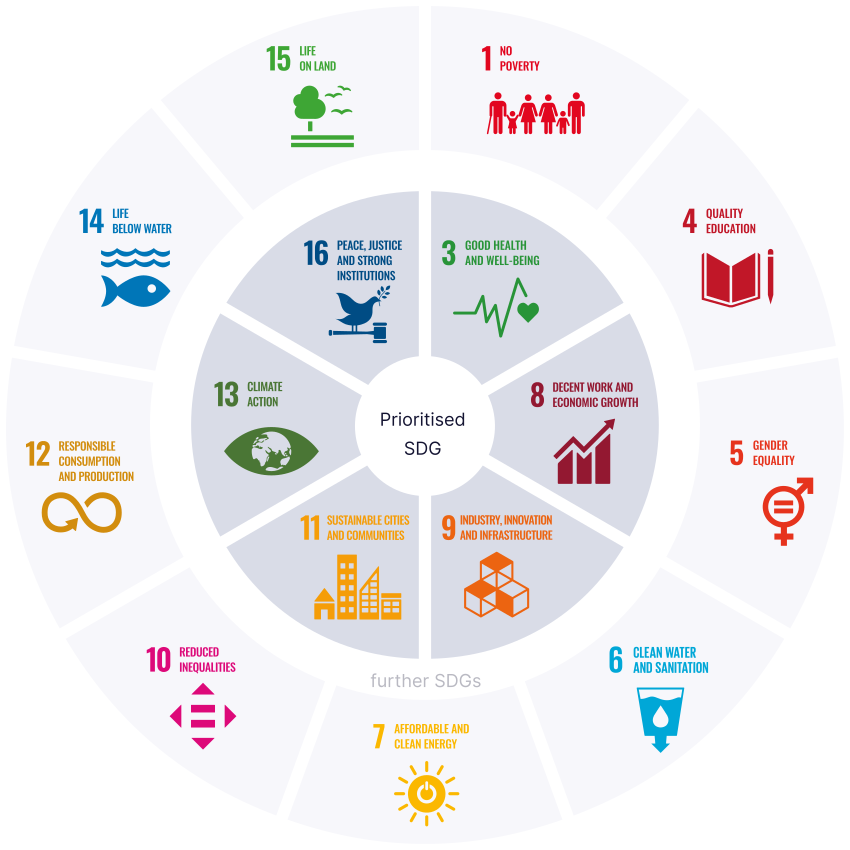
Overview of SDGs

Good health and well-being
The well-being of everyone at the airport, whether as employees, passengers, visitors or otherwise, and the protection of their health are a high priority for the Zurich Airport Group. Accidents and other incidents with adverse health consequences must be avoided. The company achieves this by instilling a culture of rigorous safety management, establishing high-quality infrastructures and offering opportunities and programmes to improve the health of employees. In addition, the company takes steps to eliminate or minimise potentially harmful emissions such as noise, air pollutants, waste and waste water.

Decent work and economic growth
By providing flight connections for passengers and freight, airports help to stimulate business growth in their region and beyond. In addition, the airports operated by the Zurich Airport Group themselves make a major contribution to regional wealth creation. They offer employment and a source of income for employees with different qualification levels, and award contracts to local companies. The Zurich Airport Group is a reliable and responsible employer which also invests in training and helping people join the workforce at all its sites.
Industry, innovation and infrastructure
The Zurich Airport Group builds, maintains and operates high-quality, durable infrastructures. It develops forward-looking concepts, such as plans for sustainable energy supply or novel construction materials, and works together with local industry, where possible, to implement them. The development of the airports involves the construction of further infrastructure such as railways, energy production or waste water treatment plants that benefit sustainable industrialisation.
Sustainable cities and communities
Airports belong to countries’ basic infrastructure, as they meet long-distance mobility needs for society in general. They also provide an economic boost. As well as contributing to the economy, the Zurich Airport Group helps to generally raise the amenity value for people living in the vicinity of its airports by meeting economic, environmental and social needs. These airports perform an important everyday role in people’s lives – as workplaces, as transport hubs, or simply as places for meeting and shopping. At the Noida site, once operations are in full swing there are plans to invest in construction and upgrades of infrastructure for the local population, including medical facilities, education, drinking water, road building and lighting.

Climate action
The aviation industry is in the spotlight as a major contributor to greenhouse gas emissions in industrialised and developing countries. Airports cause greenhouse gases due to their electricity, heating and cooling requirements as well as the consumption of fossil fuels for their vehicles. For this reason, the Zurich Airport Group aims to reduce its own greenhouse gas emissions to net zero by 2040 (Scope 1 and 2) without offsetting. Together with its partner companies, the Zurich Airport Group also aims to reduce the greenhouse gas emissions in Scope 3, such as from stationary aircraft energy supply on the airfields, or via its commitment to the use of sustainable aircraft fuels.

Peace, justice and strong institutions
As the holder of the operating licence awarded by the Confederation, the Zurich Airport Group depends on open, reliable collaboration with official authorities and institutions. Compliance with laws, respect for these institutions and cooperation with the authorities are essential for the company, and are ensured by the Group within its area of responsibility.
