
Noise
The Zurich Airport Group understands that flight operations generate noise that affects the surrounding communities. It therefore takes various measures to reduce negative impacts.
Relevance
Aircraft noise is a major consequence of flight operations and can be a nuisance for many people living in the vicinity of the Zurich site. Where noise arises and how loud it is perceived to be depends on a variety of interrelated factors. Generally speaking, how the noise spreads is determined by the orientation of the runways and flight routes. The latter depend on the nature of the terrain and the prevailing weather conditions. Other important factors include the time of day and the types of aircraft flown, which is determined by the flight schedule and the fleet used by the airlines. The type of engine technology in use and its condition also have an effect. A distinction is made between aircraft noise at the airport and further sources of noise on the airport grounds (e.g. aircraft engine testing) and construction noise.
Noise immissions are a nuisance and can have health consequences for those affected. Moreover, the same sound may be perceived differently depending on the situational circumstances. At the Zurich site, flights after 23:00 are especially likely to attract criticism. While Zurich Airport has the strictest night flight regulations in place compared to similar hubs in Europe, and aircraft noise has been decreasing for years, the number of residents affected by aircraft noise remains high. This is also due to the fact that the resident population in the affected local communities has risen sharply in recent decades.
Noise is less of an issue for the company’s majority interests in Brazil and Chile, where the volume of air traffic is much lower. In the case of Brazil, the number of flight movements at all sites is below the threshold as of which the government demands that noise be monitored. Moreover, most take-offs and landings in Brazil are over the sea, while the airports in Chile are sited well away from large conurbations. At the airport in Noida, India, a monitoring station for recording ambient noise is in operation west of the runway, and another is planned to monitor aircraft noise.
Approach and progress
Zurich Airport Ltd. strives to further reduce aircraft noise at Zurich Airport and to protect those affected using sound insulation measures. At the Zurich site, it seeks to ensure that noise does not exceed the noise limits in any residential areas outside the zone defined in the Sectoral Aviation Infrastructure Plan (SAIP). As the figures for the reporting year were not yet available on the date on which this report was published, the following information refers to target achievement in the previous year (2024) compared to the SAIP of 11 August 2021. During the day (06:00 to 22:00), the target was achieved in 2024 as well as in 2023. In the first part of the night (22:00 to 23:00), the area where the night-time noise limit was exceeded was reduced from 5.7 ha in 2023 to 3.8 ha in 2024. This can be attributed to changes in meteorological conditions, which made it possible to apply noise-optimised operating concepts more frequently. As a result of measures implemented to combat delays, the area also decreased from 114.8 to 98.3 ha in the second part of the night (23:00 to 05:00) in 2024.
The sound insulation programme comprises various passive noise mitigation measures which Zurich Airport Ltd., as the originator of the noise, is obliged to put in place at the Zurich site. These include in particular the installation of sound-insulating windows in living rooms and bedrooms. The company is aiming to roll out sound insulation measures in at least 200 further properties a year between 2022 and 2026, or alternatively to reimburse homeowners. As in previous years, this target was also achieved in the reporting year.
Reducing aircraft noise and protecting residents from noise are goals that Zurich Airport Ltd. is tackling on a wide range of levels and which it cannot achieve on its own. It relies on cooperation with numerous other stakeholders, such as the authorities in Switzerland and across the border, the responsible Federal Office of Civil Aviation (FOCA) and partner companies including airlines, in order to implement measures successfully.
Communication with local residents
Transparent information as well as dialogue with residents and organisations are key to meeting their diverse information needs. The company has therefore been reporting statistics on noise levels and flight operations for a number of decades already. For instance, the number of take-offs and landings at the Zurich site, broken down by runways and flight routes, is reported on the company’s website each day.
Residents affected by aircraft noise can call or use an online form to contact Zurich Airport Ltd. directly with any queries or concerns, and staff from the Noise Management department respond to specific questions.
Besides individuals, a number of bodies including municipalities in the airport vicinity, the Canton of Zurich and other neighbouring cantons, districts across the border in Germany and a variety of public bodies and citizens’ organisations approach Zurich Airport with concerns related to air traffic noise. The company also maintains regular dialogue with these groups.
In the reporting year, the number of enquiries and complaints declined by 7% to 2,586 compared to the previous year. The most common cause of enquiries and complaints were northbound take-offs and evening flights from the south.
Despite the significantly lower level of interest from residents, the sites in Brazil also each operate their own channels to provide noise information and receive complaints. The environmental licences of these airports are subject to the obligation to set up an easily accessible digital hotline for noise complaints and to submit quarterly reports to the authorities. See the Business ethics section for more information on public complaints channels.
Noise monitoring
In order to objectively assess the noise situation and levy noise-related charges, it is necessary to have accurate measurements of noise levels. Data on air traffic noise in the vicinity of Zurich Airport has been collected since 1966. The airport operates a network of noise monitoring terminals that are currently installed at 14 fixed locations near take-off and approach routes. The noise monitoring system was comprehensively modernised in early 2025. The monitoring terminals now record noise events even more precisely, and an automated process assigns these events to the respective flight movements much more reliably. This data is published monthly in a noise report that can be freely accessed on the company’s website. As prescribed by the Sectoral Aviation Infrastructure Plan (SAIP), aircraft noise exposure and the progress of mitigation measures are analysed in a comprehensive report each year and submitted to the Federal Office of Civil Aviation (FOCA). This report is then used as the basis for taking action (see Night flights and special authorisations).
The number of take-offs and landings increased by 3.5% year-on-year in the year under review. Nevertheless, exposure to aircraft noise during daytime hours at the four most important monitoring points was the same as recorded in the previous year.
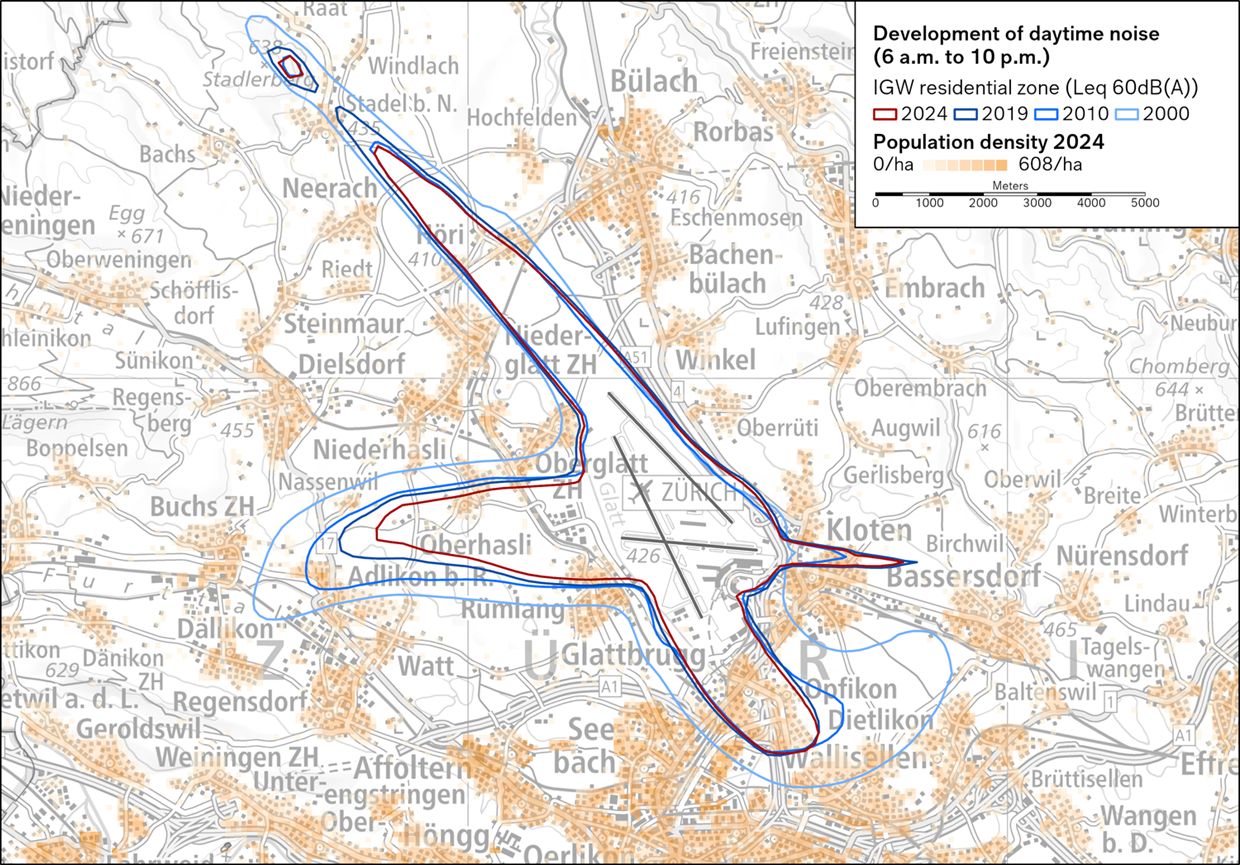
Daytime noise trends (06:00 to 22:00), noise limits (IGW) for residential zones (Leq = 60 dB(A))
Sources: EMPA, Statistical Office of the Canton of Zurich, swisstopo
The diagram above shows changes in exposure to aircraft noise during daytime hours (06:00 to 22:00) over time at Zurich Airport. It shows the noise contour for noise limits in residential zones for various years, with the enclosed area representing threshold breaches. The comparison shows a reduction in the area over the years and hence a reduction in noise levels despite a steady rate or increasing amounts of air traffic. This reduction is due to technical advances in aircraft construction and the associated noise reduction. The noise contours for the reporting year will not be available until mid-2026.
Take-off route monitoring
Take-off routes from Zurich Airport were configured to avoid low overflights of densely populated areas wherever possible. The Noise Management department monitors all aircraft departing Zurich Airport for adherence to the prescribed flight routes. During daytime hours, these are mandatory at least up to an altitude of 5,000 feet (approx. 1,500 m above sea level) and at night up to flight level 80 (approx. 8,000 feet or 2,500 m above sea level). Compliance with flight routes is monitored using a monitoring system.
An aircraft may only deviate from the prescribed flight route if there is good reason to do so, for instance to avoid storm clouds or following instructions from an air traffic controller. If there is no legitimate reason, an investigation is triggered, and the pilot in question will be asked to submit a statement in writing. These investigations often also involve interviews with representatives of the airlines. If the investigators are not satisfied, the matter may be referred to FOCA. This constant monitoring encourages the airlines to optimise the take-off phase at all times.
As in the previous year, the most frequent reason for deviations from the prescribed flight paths were specific instructions from air traffic control. A total of 102 (2024: 145) investigations into unjustified deviations were launched, and 13 (2024: 29) interviews were held with chief pilots.
Night flights and special authorisations
Night-time flights are perceived as a particular nuisance. At the Zurich site, flights after 23:00 in particular give rise to complaints; these flights are mainly attributable to delays over the course of the day. The situation improved noticeably in the reporting year thanks to a programme of measures carried out with the partner companies. Staffing levels were increased, cameras were installed at all docking bays and processes were optimised. An important role is played by the improved support provided by an app that makes comprehensive flight operations information directly available to all interested personnel, including partner companies, enabling them to make independent decisions and improve efficiency.
Further measures aimed at achieving lasting improvements in punctuality and therefore reducing night-time noise, such as better separation of take-off and approach routes or extending the two shorter runways, are pending in the procedure used to amend the operating regulations.
In 2025, 2,818 flights (2024: 3,389) were operated between 23:00 and 06:00. The investments made and measures implemented to improve punctuality are having a positive impact. A total of 201 flights (2024: 411 flights) operated during the night-time curfew period (23:30 to 06:00) were given special authorisation. These night flights are authorised only for legitimate reasons (see Noise statistics). The night flights were due to restrictions in European airspace, technical disruptions to the aircraft and difficult meteorological conditions.
Use of the noise protection hangar
The noise protection hangar helps to significantly reduce noise from aircraft engine testing. It is dimensioned to accommodate an aircraft up to the size of a Boeing 747-800. Although it significantly reduces noise exposure for nearby residents, the noise protection hangar does not completely eliminate the noise, so there are set limits for the number of tests that may be run.
In 2025, a total of 479 (2024: 449) aircraft ground tests were carried out in the noise protection hangar. According to the Federal Noise Abatement Ordinance (Lärmschutzverordnung, LSV), the period falling between 19:00 and 07:00 counts as night-time for the purpose of assessing idling noise. Of the 172 idling processes carried out during the night, 84% related to short and medium-haul aircraft and business jets. On the other hand, long-haul aircraft were primarily tested during the day from 07:00 to 19:00. The permissible noise exposure level was exceeded 6 times. The breaches were caused by extended full-throttle tests during the night between 19:00 and 07:00. According to the agreement concluded with the neighbouring municipalities, the permitted level may not be exceeded more than 25 times during any given year. One engine idling above idle power level test was carried out outside the hangar in the reporting year because the noise protection hangar was unavailable due to maintenance work.
Noise charges and the Airport Zurich Noise Fund
Levying noise-related charges gives airlines a financial incentive to operate the quietest possible aircraft on their Zurich routes. All jet aircraft are assigned to one of five noise classes, each of which has a different charge rate based on the time of take-off and landing. In addition, shoulder and night-time surcharges are applied to flights between 21:00 and 07:00. These may vary according to noise class and the specific take-off or landing time. In the reporting year, FOCA ordered a reclassification of noise classes and an increase in noise surcharges in the second part of the night, which will enter into force by 2027 at the latest.
Until the end of 2020, all income from noise charges was credited to the Airport Zurich Noise Fund (AZNF). AZNF funds are used primarily to cover the costs of sound insulation measures, in particular the sound insulation programme, the south-side sound insulation concept and the costs of meeting compensation claims for noise and overflying. As the law currently stands, the AZNF has sufficient assets to cover the known future costs for these purposes. Since then, therefore, revenue from aircraft noise charges has been reallocated to the “Aviation” segment. Further details about the AZNF can be found in Note 20, Airport Zurich Noise Fund.
A total of CHF 15.3 million in revenue was generated from aircraft noise charges in 2025. Of this, CHF 6.7 million were from standard noise charges applicable to all 24 hours and CHF 8.6 million from surcharges levied during shoulder periods and at night.
Sound insulation
As the airport operator, Zurich Airport Ltd. is obliged to pay the costs of sound insulation measures in properties in the communities around Zurich Airport that are exposed to excessive aircraft noise. This is primarily for the installation of sound-insulating windows as part of the noise protection programme. Property owners who have already taken the initiative of fitting sound-insulating windows themselves are reimbursed by Zurich Airport Ltd. The company met its target of installing sound-insulating windows in at least 200 further properties a year between 2022 and 2026, or alternatively of reimbursing homeowners in the year under review with 233 properties (properties with their own house number).
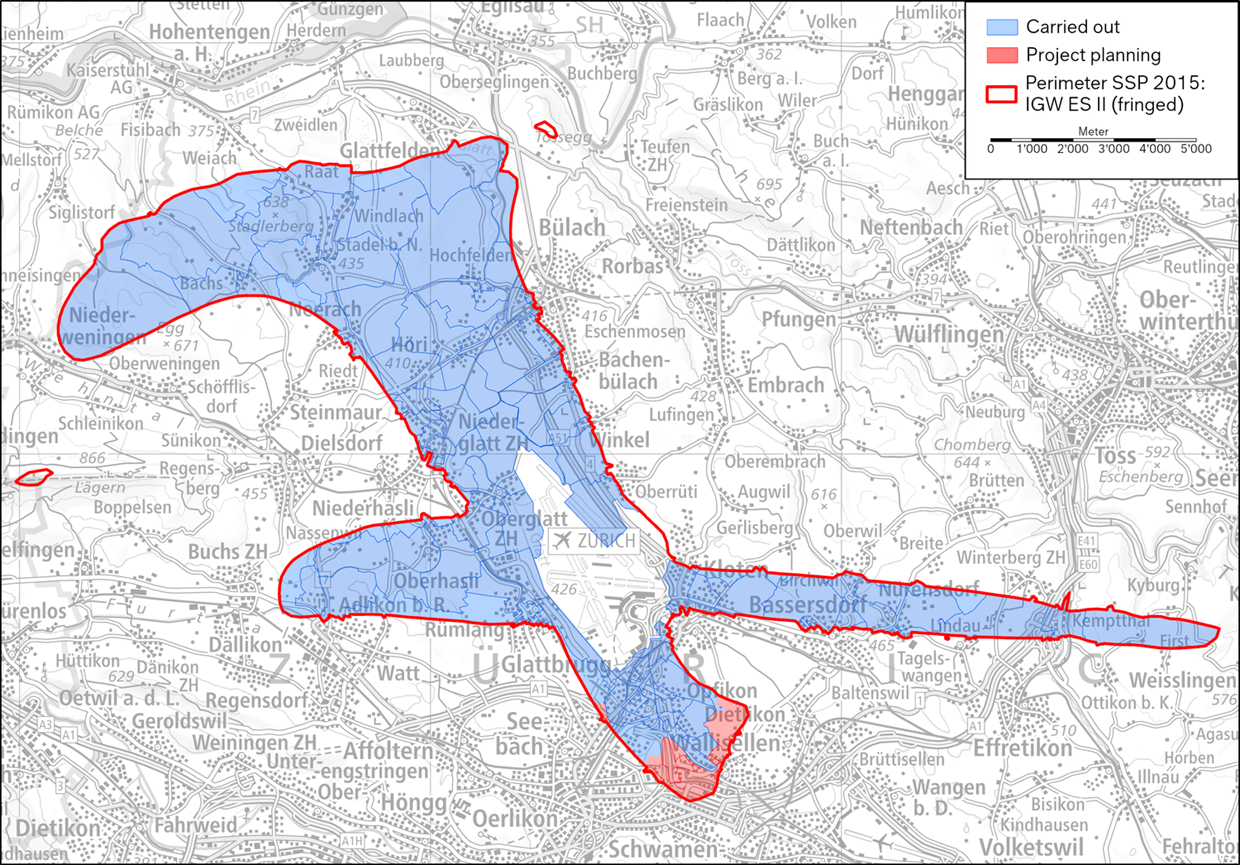
Sound insulation programme – window measures in 2025; background map source: swisstopo
In addition, in areas where night-time noise exposure limits are exceeded, the company offers owners the option of installing automatic window-closing systems or sound-absorbing ventilators. Owners of properties with bedrooms which are located within a clearly defined perimeter, and which were not subject to any obligation to install sound insulation during construction or conversion, are eligible to benefit from these passive sound insulation measures.
From 1999 up to and including 2025, approximately CHF 340 million was spent on sound insulation measures in around 6,240 buildings as part of the sound insulation programme and the south-side sound insulation concept. Of the CHF 13.6 million expenditure in 2025, CHF 0.8 million was attributable to project planning, CHF 10.5 million to refurbishments and CHF 2.3 million to reimbursements. This expenditure was funded entirely by AZNF.
Zurich Airport Ltd.’s south-side sound insulation concept is designed to prevent local residents being awoken by early-morning inbound flights from the south. At the request of owners, the company will install automated window-closing systems or sound-absorbing ventilators in bedrooms in the areas affected. As part of the south-side sound insulation concept, around 70 window closers and 680 sound-absorbing ventilators were installed in bedrooms by the end of 2025. The total costs amounted to around CHF 1.2 million.
Noise compensation (formal expropriations)
As air traffic noise can affect the value of a property, the company is faced with around 20,100 claims for compensation from property owners around the Zurich site. The compensation claims were submitted at the time the airport was privatised and following the imposition by Germany of restrictions on flight approaches over its territory. Any new claims may now only be submitted if there are substantial changes to flight operations; as a result, no further claims have been submitted to Zurich Airport Ltd. since then. Of the compensation claims received, 15,073 (75%) had been concluded by the end of 2025, with CHF 90.7 million being paid in noise compensation. All noise compensation claims are paid from the Airport Zurich Noise Fund (AZNF).
As there are very few provisions regarding noise compensation or direct overflights in federal legislation, every open question of law must first be tested in the relevant courts. Legal test cases are being conducted in the interests of processing outstanding claims efficiently. They are helpful both for clarifying questions of law and for obtaining legal rulings regarding the specific situation in the various airport regions.
Noise statistics for Zurich Airport
Zurich Airport, Switzerland | 2021 | 2022 | 2023 | 2024 | 2025 | |||||
Number of residents above immission limit 1 | 17,449 | 49,143 | 59,124 | 56,589 | n/a2 | |||||
Total residential area outside SAIP immission limit (ha)3 | 0.0 | 77.7 | 120.5 | 102.0 | n/a2 | |||||
Residential area daytime (06:00 – 23:00) outside SAIP immission limit (ha) | 0.0 | 0.0 | 0.0 | 0.0 | n/a2 | |||||
Residential area 1st night hour (22:00 – 23:00) outside SAIP immission limit (ha) | 0.0 | 16.9 | 5.7 | 3.8 | n/a2 | |||||
Residential area 2nd night hour (23:00 – 05:00) outside SAIP immission limit (ha) | 0.0 | 60.8 | 114.8 | 98.3 | n/a2 | |||||
Daytime aircraft noise levels4 at NMT 1/3/6/10 (dB[A])5 | 62/55/60/54 | 64/57/64/57 | 64/59/65/59 | 66/58/66/58 | 66/58/66/58 | |||||
Number of engine ground tests in the noise protection hangar during the day/night | 284/93 | 58/23 | 307/109 | 318/131 | 307/172 | |||||
of which number of exceedances of the permissible noise exposure level | 6 | 0 | 2 | 6 | 6 | |||||
outside the noise protection hangar during the day/night | 19/2 | 134/13 | 8/0 | 0/0 | 1/0 | |||||
Number of registered flight path deviations/investigated | 4,584/89 | 4,837/138 | 5,202/132 | 5,046/145 | 4,900/102 | |||||
Number of night flight movements (22:00 – 06:00) | 4,422 | 10,109 | 13,564 | 14,612 | 14,540 | |||||
of which in the first night hour (22:00 – 23:00) | 3,755 | 7,733 | 10,058 | 11,214 | 11,722 | |||||
Number of special authorisations for night flights issued6 | 75 | 241 | 310 | 411 | 201 | |||||
of which emergency, relief and rescue flights | 23 | 38 | 30 | 30 | 43 | |||||
of which police, military and government flights | 1 | 7 | 9 | 16 | 8 | |||||
of which various other types of flight | 51 | 196 | 271 | 365 | 150 | |||||
2010 Sound Insulation Programme: number of properties fitted7 | 5,350 | 5,560 | 5,760 | 6,010 | 6,240 | |||||
Number of complaints and enquiries relating to noise8 | 817 | 3,330 | 2,695 | 2,770 | 2,586 |
1Encompassing noise contours; Information and maps on threshold values as well as on alarm and planning values can be found at www.flughafen-zuerich.com/fluglaerm.
2Figures will be calculated by Empa and published only after this report is published.
3Noise limit SAIP = area where noise limits are exceeded in the Sectoral Aviation Infrastructure Plan and in the structure plan of the Canton of Zurich.
4Energy-equivalent continuous sound level of daytime aircraft noise (06:00 – 22:00).
5NMT = Noise Monitoring Terminal, 1 = Rümlang, 3 = Oberglatt, 6 = Glattbrugg, 10 = Nürensdorf.
6Special authorisations can be granted during the night-time curfew period in the event of unforeseeable extraordinary events.
7Number of buildings and properties renovated to date, incl. Reimbursements.
8Includes complaints and enquiries relating to noise nuisance, flight paths, increased air traffic, etc.
