
Climate and energy
The Zurich Airport Group aims to reduce its greenhouse gas emissions in Scopes 1 and 2 to net zero by 2040. It is also adopting measures to resolve the challenges of climate change.
Relevance
The Zurich Airport Group has resolved to reduce its own greenhouse gas emissions (Scopes 1 and 2) to net zero by the year 2040 in order to help limit the global temperature increase to well below two degrees in accordance with the Paris Agreement (see Net zero roadmap). At the same time, the company faces complex risks as a result of climate change, which it must identify and find solutions to. Encompassing the four elements of strategy, governance, risk management and key data pursuant to the recommendations of the Task Force on Climate-Related Financial Disclosures (TCFD), this report meets the requirements of the Ordinance on Climate Disclosures (Article 3) and of Article 964b CO (Swiss Code of Obligations).
Every year, Zurich Airport Ltd. records the greenhouse gas emissions per site as CO2 equivalents in an inventory in accordance with the Greenhouse Gas Protocol standard; this means they are classified by source into three spheres of influence (Scopes 1 to 3; see Key data). Scope 1 covers the direct sources at the Zurich site and primarily includes heating systems, the site’s own electricity generation and the vehicle fleet. Scope 2 relates to emissions resulting from generating the energy purchased from external suppliers. Lastly, Scope 3 covers all other airport-related sources of emissions (e.g. ground handling and aircraft, including flights to the final destination) plus the other sources from upstream and downstream processes (for example, in connection with land-side access traffic, energy production and goods procurement). At more than 99%, the vast majority of all greenhouse gas emissions, including those generated along the entire value chain, are attributed to Scope 3. For this reason, Zurich Airport Ltd. also makes every effort to use its scope for action in Scope 3 and to provide targeted support to all partners in the upstream and downstream value chain in their measures to reduce greenhouse gas emissions.
With accreditation from Airport Carbon Accreditation (ACA) for the Zurich, Florianópolis, Vitória and Macaé sites, the progress made in reducing greenhouse gas emissions is comparable with other airports internationally and is also externally audited.
Climate strategy
Net zero roadmap
The Net zero roadmap is how the Zurich Airport Group plans the transition to a low-carbon economy. It was revised again in the reporting year and supplemented in particular with information on Scope 3 and the areas of action of Zurich Airport Ltd. The defined net zero roadmap is in line with the objectives of the Paris Agreement and is compatible with Swiss climate targets. It aims to achieve net-zero greenhouse gas emissions (Scopes 1 and 2) at all sites by 2040 without purchasing carbon offset certificates. Net zero means that the remaining greenhouse gas emissions caused by humans have to be removed from the atmosphere, resulting in a zero balance. The first interim target at the Zurich site, which is to reduce annual greenhouse gas emissions to just 30,000 tonnes from 2020, has already been reached. As another interim target, the company is aiming to reduce its annual greenhouse gas emissions at the Zurich site to just 20,000 tonnes by 2030. To help it meet these targets, the company has drawn up a step-by step reduction roadmap.
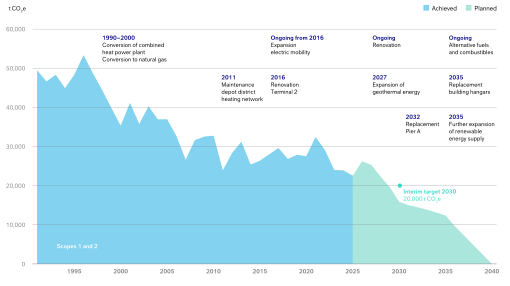
Greenhouse gas emissions of Zurich Airport Ltd. at the Zurich site since 1991 and the planned reduction roadmap up to 2040.
The total investment costs of the net zero roadmap of Zurich Airport Ltd. at the Zurich site amount to around over CHF 300 million between 2024 and 2040. Approximately 40% is attributable to the transformation of the supply of heating and cooling energy, which will account for a significant share of greenhouse gas savings by 2040. More than a quarter is attributable to the expansion of photovoltaic arrays and long-term power supply agreements, and the rest to e-mobility, building renovations and optimised operations.
The Group-wide net-zero target by 2040 also applies to the majority-owned locations abroad (see Net zero roadmap). In India, where the airport in Noida is about to begin operations, the intention is also to reduce greenhouse gases to net zero as early as 2030. The transition plan for this is currently being drawn up.
Airport Carbon Accreditation
Zurich Airport Ltd. has been accredited by the Airport Carbon Accreditation (ACA) programme for its approach to reducing greenhouse gases and its net zero roadmap. This is the widely recognised global climate protection programme run by Airports Council International (ACI), which helps airports effectively reduce their greenhouse gas emissions and grades their progress. The Zurich site is accredited at level four out of five; this level of the programme is comparable with other frameworks such as the Science-Based Targets Initiative (SBTi). In addition to the reduction of greenhouse gases, a target for achieving net-zero greenhouse gas emissions in Scopes 1 and 2 and the corresponding reduction roadmap with documented measures, this level also requires partner companies to be encouraged to reduce greenhouse gas emissions. In the reporting year, the targets, key data and programmes of Zurich Airport Ltd. were once again recertified by the externally independent verification body IFU-CERT. Since February 2025, three of the airports with majority interests in Brazil, namely Florianópolis, Vitória and Macaé, have also been accredited at level four. Accreditation is planned for Natal in 2026, and for Noida Airport by 2027.
Energy and climate leader
Through its participation in the Swiss Confederation’s Exemplary Energy and Climate initiative, Zurich Airport Ltd. is underscoring its ambition at the Zurich site to play a pioneering role in climate protection and energy. As a participant in the initiative, it is taking specific measures to increase energy efficiency, expand the use of renewable energies and reduce greenhouse gas emissions.
Circular Building Charter
Zurich Airport Ltd. has also been a member of the “Charta Kreislauffähiges Bauen” (Circular Building Charter) since 2024. Its aim is to reduce grey greenhouse gas emissions significantly in the building sector and massively increase the recyclability of buildings through improved dismantling and material reuse.
Climate risks and opportunities
As the Zurich Airport Group is affected directly by the longer-term changes in climate patterns, this also influences its strategy. While the company has long understood the need to transition to a low-carbon economy and has reduced its own greenhouse gas emissions at the Zurich site by approximately 50% since 1991, the risks to its business activities and relevant strategies to adapt to the changing climate are gaining ever greater focus.
In the years 2023 and 2024, the Zurich Airport Group identified its climate-related physical risks and transition risks throughout the Group and evaluated them at its sites in Switzerland, Brazil, Chile and India for the monitoring periods of 2040 and 2050+ as well as the emission scenarios (Representative Concentration Pathways, RCP) RCP2.6 and RCP8.5 of the Intergovernmental Panel on Climate Change. Depending on the location, the time horizons have been aligned with the transition plan, the life cycle of the infrastructure and the concession period for each airport. Handling direct physical events that can occur at any time is already part of the company’s day-to-day business.
Physical risks at the Zurich site
Drivers of climate risk | Risk and impact | |
• Higher mean temperatures • More extreme heat waves • Dry spells in the summer | Heat-induced stress for personnel, service providers and passengers outdoors: Higher operating expenses for preventive health protection, lost productivity | |
Damage to the asphalt runways caused by heat: Higher maintenance costs, additional operating expenses and higher depreciation in tandem with reduced service lives, shorter investment cycles for runway repairs | ||
Increased building cooling requirements: Higher operating expenses as a result of greater energy requirements, investments in scaling up climate control systems | ||
Desiccated moorland in the summer: Higher maintenance costs, potential investments in enhancements to moorland recultivation projects/compensation measures | ||
• Increased incidence of extreme weather events (heavy rainfall, extreme winds, thunderstorms) | Flooding of airside areas and landside access routes: Temporary disruptions to operations, higher maintenance costs, potential investments in flood protection and improvements to drainage systems | |
Water leakages inside buildings: Damage to physical assets and maintenance costs, potential investments in improvements to drainage systems, temporary disruptions to operations | ||
Damage to buildings and disruptions to operations caused by heavy winds: Damage to physical assets, temporary disruptions to or restrictions in operations, potentially higher operating expenses for addressing irregularities | ||
Suspension of handling and aircraft filling operations in the event of lightning strikes: Potential increase in temporary disruptions to operations and, resulting from this, delays, higher operating expenses for addressing irregularities | ||
Disruptions to flight plans caused by serious meteorological events at other airports: Effects such as delays, rerouting, cancellations |
In addition to the Zurich site, further physical risks were identified at the sites in Brazil, Chile and India: firstly, rising sea levels and the associated risk of more frequent flooding for Macaé Airport, which is located just a few metres above sea level. Secondly, longer periods of drought and related water shortages (Vitória, Natal, Antofagasta, Iquique, Noida) as well as dust formation (Noida). Thirdly, wildfires due to drought near the airports that impair air quality, affect the airport complex or interfere with flight operations due to smoke formation (airports in Brazil and Noida).
Climate resilience
To handle the physical risks identified, the Zurich Airport Group has defined four areas of action:
- Construction activity for renovations or new construction of buildings and installations
- Optimisation of operations through the use of new technologies
- Short-term operational interventions
- Monitoring
Climate events based on the current, country-specific climate scenarios have already been factored into the planning and implementation of plans (especially for extensive infrastructure projects). Examples include the use of resistant materials and changes in dimensions for renovated or newly constructed buildings and installations. In order to counteract the negative effects of climate change in day-to-day operations, Zurich Airport Ltd. is examining technical adaptations to meet the increased cooling requirements as well as workplace measures in the event of extreme heat. Increased monitoring is used to track and analyse direct and indirect climate-related events, with the findings being taken into account when planning subsequent changes.
Transition risks
Drivers | Risk and impact | |
Market | Loss of market share due to changed customer preferences and air traffic patterns | |
Energy and technology | Higher sourcing costs as a result of the transition to renewable energies (and carbon removal) in tandem with increased demand and limited availability | |
Loss of reputation due to insufficient development progress and limited availability of low-emission energies and technologies for aviation | ||
Reputation | Impaired access to affordable financing due to the heightened decarbonisation expectations of the capital market | |
Political and regulatory aspects | Limited growth due to more expensive air travel as a result of regulatory factors | |
Delays in construction projects and operations due to heightened political pressure on underlying conditions for operations and development projects | ||
Increased operating expenses due to upside pressure on expenses as a result of environmental regulations |
Opportunities
Apart from the risks, climate change and the related transition to a low-carbon economy also offer opportunities for the Zurich Airport Group. Operating cost savings can be achieved thanks to energy efficiency and substitution measures as well as due to the expected global warming and the resulting reduction of heating requirements in winter. Changes in client preferences related to the changing climate may also open up new income opportunities. Finally, investments in a resilient infrastructure foster general resilience to changing market and environmental conditions.
Climate governance and risk management
Governance
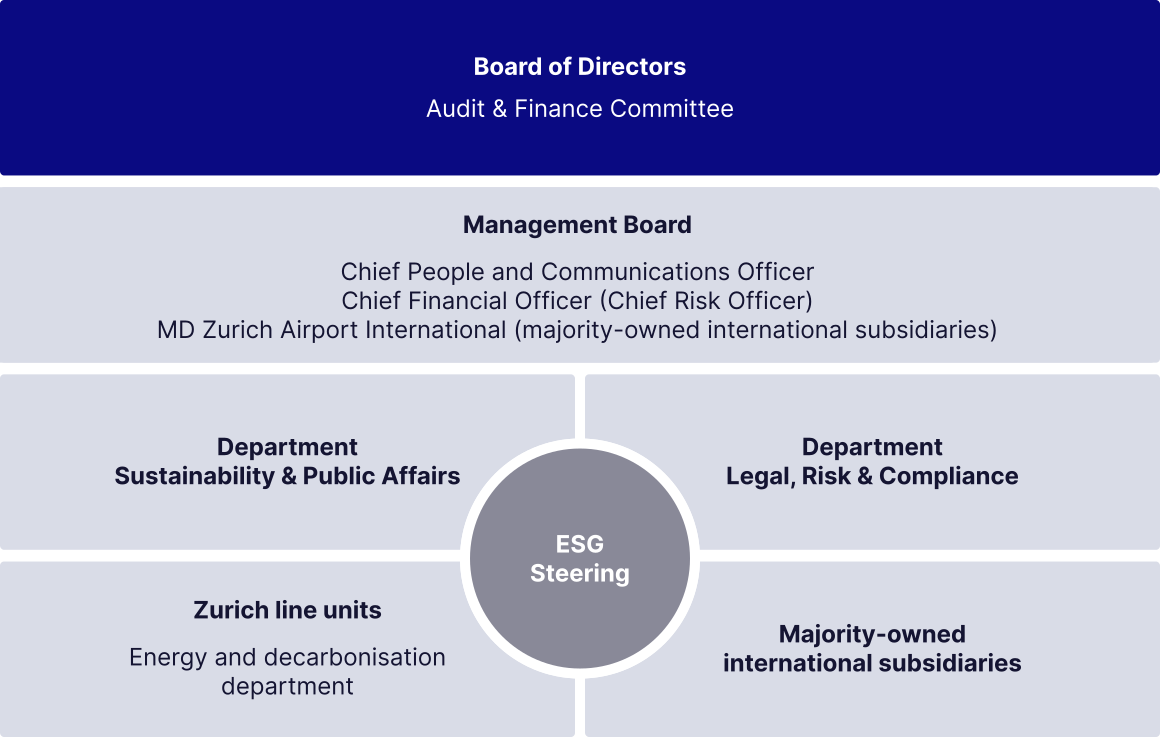
As one of the five material sustainability topics, climate is part of the Zurich Airport Group’s strategic focus and is included in the overall sustainability governance system. The Board of Directors has primary responsibility for the company’s sustainable alignment. At least once a year, it is informed of the current status of the climate programme, including climate risks, and decides on strategic aspects relating to sustainability matters. As a committee of the Board of Directors, the Audit & Finance Committee is in charge of sustainability reporting, and thus also of climate reporting.
The Management Board is responsible for implementing the sustainability strategy. It agrees on targets and plans of action, and focuses on climate matters during the annual management review on sustainability. Furthermore, the Management Board and Board of Directors are notified of climate matters in relation to credit applications or general situation assessments. Within the Management Board, the topic of sustainability and therefore of the climate, as well, has been assigned to the Chief People & Communications Officer (CPCO) since October of the reporting year. This person is the line manager of the new Sustainability & Public Affairs department – the point of coordination for climate-related topics (for current information, see Organisational structure). The head of department chairs the ESG Steering Committee, which coordinates the sustainability topics throughout the company, with climate being one of the 15 sustainability topics. Responsibility for climate-related risks and opportunities is anchored in Group-wide risk management. As Chief Risk Officer, the Chief Financial Officer assumes overall responsibility and is supported by the Group Risk Office, which sets minimum requirements and manages risk reporting centrally. The members of the Management Board are responsible for identifying and managing the risks assigned to them in accordance with the risk ownership concept. The responsibility for climate-related risks and opportunities of the international Group locations lies with the Managing Director of Zurich Airport International, who is also a member of the Management Board.
Climate governance
Risk management
The climate-related risks and opportunities for the Zurich Airport Group were determined for the individual sites as part of various climate impact assessments and assessed in terms of probability of occurrence and potential impacts. The assessment was largely qualitative, based on an extensive consultation process with experts from the business divisions in question. The current Swiss climate scenarios served as the basis at the Zurich site, while the corresponding national bases served the same purposes in Brazil and Chile. At the Noida site in India, a detailed risk analysis is scheduled to be carried out after the site’s commissioning. The risk assessment was based on the framework from the general risk management provisions of the Zurich Airport Group. In future, the identification and assessment of climate-related risks will be incorporated into the company-wide risk management tool and into an integrated risk report submitted to the Management Board and the Board of Directors.
The line units are responsible for addressing climate-related risks, which is why each risk is assigned to a responsible department. As the risk owner, the head of division decides on the implementation of suitable adaptation measures, all of which were systematically recorded in an adaptation plan in the reporting year (see Climate resilience). Greenhouse gas emissions have been reduced for years through the use of numerous measures (see Net zero roadmap). They are implemented by the relevant line units.
Measures and progress
The “2040 master plan for energy and decarbonisation of real estate” makes the greatest contribution to reducing Scope 1 greenhouse gas emissions. For one thing, this includes various measures to reduce the demand for heating, cooling and electrical energy at the Zurich site. For another, it provides for switching the method of energy provision to non-fossil alternatives. At present, the biggest contributor to Scope 1 emissions is the airport’s own combined heat and power generation plant, which both produces electricity for the airport and distributes heat over a district heating network. This combined heat and power plant runs on natural gas or heating oil. The switch to non-fossil fuels should start making a significant contribution to reducing the remaining greenhouse gas emissions by 2035 at the latest.
By optimising its systems and renovating existing buildings to improve energy performance, Zurich Airport Ltd. is increasing the energy efficiency of the Zurich site from year to year. When it comes to making the switch to a fossil-free heat supply, the focus is on three projects: seasonal energy storage, the “Mitte” energy facility and the technical consumer adaptation to a low-temperature grid. From 2027, a glacial channel at a depth of around 300 metres underground is scheduled to be used as a seasonal thermal storage facility to meet part of the heating and cooling requirements in the main airport complex. In the reporting year, further tests were carried out and adjustments were made to the temporary installations; as a result, the technical feasibility of the first two wells is largely ensured.
Construction of the “Mitte” energy facility began as planned in the reporting year. As an energy plant housing heat pumps and cooling units, it provides the link between the seasonal storage system and the consumers adapted to the low-temperature grid. One main feature of the latter is the new Dock A, which is scheduled to be built starting in 2030. Much of the airport’s infrastructure, including Dock E, the Circle and parts of the maintenance area, is already being supplied with heating and cooling via the underground energy source (borehole heat exchangers). The Circle operates almost entirely without fossil fuels and has been certified with the LEED Platinum sustainability label as well as the Minergie building standard.
Zurich Airport Ltd. produces electricity all year round via its photovoltaic arrays and, in winter, with its heating plant. Two new photovoltaic arrays on the roofs of the hangar area went into operation in the reporting year. More photovoltaic arrays will be added in the coming years. Since the year under review, the airport has also purchased electricity exclusively from renewable sources from the industrial plants in Kloten to cover its entire electricity requirements.
Besides buildings, vehicles are also a significant source of greenhouse gases. The transition to electric vehicles, which has been underway for some years already, continued in the reporting year. All four compact sweepers were electrified, while the electrification of passenger cars was also further expanded. In addition, since the end of the reporting year, the first fuel station at the airport has been operated with HVO (hydrotreated vegetable oil, a non-fossil diesel from waste and residual materials) and synthetic diesel from Synhelion was tested in a passenger bus (see Net zero roadmap). The increase in the number of battery-powered vehicles is linked to the ongoing expansion of the charging infrastructure. In the reporting year, a further 119 charging stations and three high-speed chargers went into operation for the vehicles of Zurich Airport Ltd. and its partner companies.
Value chain
With its dual strategy, at the airport and in the air, Zurich Airport Ltd. also influences the upstream and downstream value chain at the Zurich site (Scope 3). The focus here, for example, is on land-side transport to and from the airport, aircraft handling and support for the aviation industry’s measures to achieve the net-zero target by 2050.
On the one hand, land-side transport at the airport is shaped by the federal government’s target of handling a total of 46% of arrivals and departures by public transport by the year 2030. This figure has risen steadily in recent years and already met the target of 46% in the reporting year. In addition, public transport to and from the airport is increasingly electric. Meanwhile, the electrification of road traffic is being supported with electric charging stations in the car parks of Zurich Airport Ltd. Finally, the company provides its own employees with financial support for the use of public transport, while parking is subject to a charge.
Companies that received ground-handling licences in the reporting year, which were issued for the next seven years, are required to present their own net-zero target by 2050. They and all other partner companies are actively supported in electrifying their fleets through the expansion of the necessary charging infrastructure for electrically powered vehicles and machines at the Zurich site. This measure is complemented by the availability of fuels from non-fossil raw materials as a bridge technology. Another measure with a direct effect on reducing greenhouse gas emissions for aircraft is the fixed ground power system, which supplies aircraft with electricity and air conditioning, replacing the use of kerosene-powered auxiliary engines. There is an obligation to use these facilities at Zurich Airport. The same type of systems for supplying electrical power and air conditioning to the aircraft also entered into operation at the Florianópolis, Vitória and Natal airports in Brazil.
In the air, the switch to alternative and sustainable aviation fuels (SAF) is a key pillar for reducing greenhouse gas emissions, which account for by far the largest proportion of Scope 3 emissions of Zurich Airport Ltd. The company supports the commercialisation of SAF in its role as a competence center and backs the introduction of an admixture quota in Switzerland that is harmonised with the EU. It has also entered into an agreement with Synhelion AG for the future purchase of synthetic diesel fuel (by-product of SAF production) (see also Net zero roadmap). However, as the objectives and measures of international aviation are regulated by the Swiss Confederation on the basis of the obligations of the ICAO (International Civil Aviation Organisation), Zurich Airport Ltd. has limited possibilities for direct action.
Scope 3 emissions at the Zurich site
Zurich Airport Ltd., Zurich Site | Unit | 2025 | ||
CO2e Scope 3 | Tonnes | 4,773,132 | ||
Purchased goods and services (3.1) | Tonnes | 42,189 | ||
Capital goods (3.2) | Tonnes | 21,028 | ||
Fuel- and energy-related activities (3.3) | Tonnes | 23,868 | ||
Upstream transportation and distribution (3.4) | Tonnes | 2,303 | ||
Waste generation in operation (3.5) | Tonnes | 2,886 | ||
Business travel (3.6) | Tonnes | 402 | ||
Employee commuting (3.7) | Tonnes | 504 | ||
Use of sold products (3.11) | Tonnes | 4,679,637 | ||
Downstream leased assets (3.13) | Tonnes | 315 |
Sites abroad
The majority interests abroad focus primarily on energy efficiency measures, the use of renewable energies and the electrification of the vehicle fleet. Photovoltaic arrays are being built at several sites in Brazil. In Macaé and Natal, the arrays are about to be commissioned, while in Vitória, construction is planned for 2026. Electric forklifts are also now being used in Florianópolis.
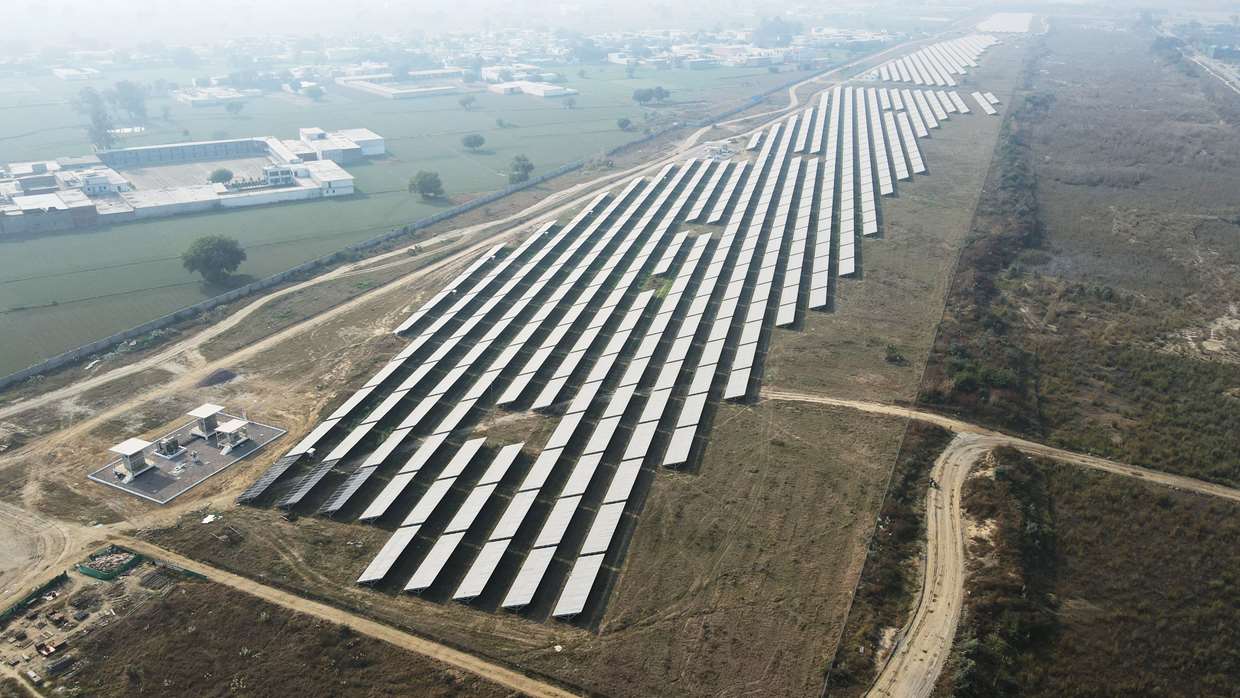
The free-standing photovoltaic array south of the airport grounds in Noida.
A number of projects have been implemented at Noida Airport in preparation for the when the airport commences operation. These include a large free-standing photovoltaic array, an initial series of electric vehicles and machines, as well as smart solar-powered road lighting. The partner companies with concession contracts for other airport services, such as handling, are also obliged to use battery-powered vehicles. Finally, the quantity of greenhouse gas emissions was introduced as a critical criterion in the procurement process.
Situation in the reporting year
Scope 1 greenhouse gases at the Zurich site were reduced further in the reporting year. This is primarily attributable to the increase in the share of biogas. As biogas has a lower emission factor than fossil natural gas, its climate impact was lower despite rising demand for heat. Furthermore, 100% of the electricity procured in the reporting year came from renewable sources for the first time. This means an increase in the share of hydropower along with a shift away from nuclear energy. While hydropower may be a renewable source of energy, it is associated with a higher emission factor (meaning higher greenhouse gas emissions per unit of electricity); Scope 2 greenhouse gas emissions increased as a result. Nevertheless, total Scope 1 and 2 emissions were reduced significantly in the reporting year.
Overall, the emission reductions of Zurich Airport Ltd. put it on track to achieving the targets of its net zero roadmap. The Zurich Airport Group shows a Group total for Scopes 1 and 2 for the first time in this report.
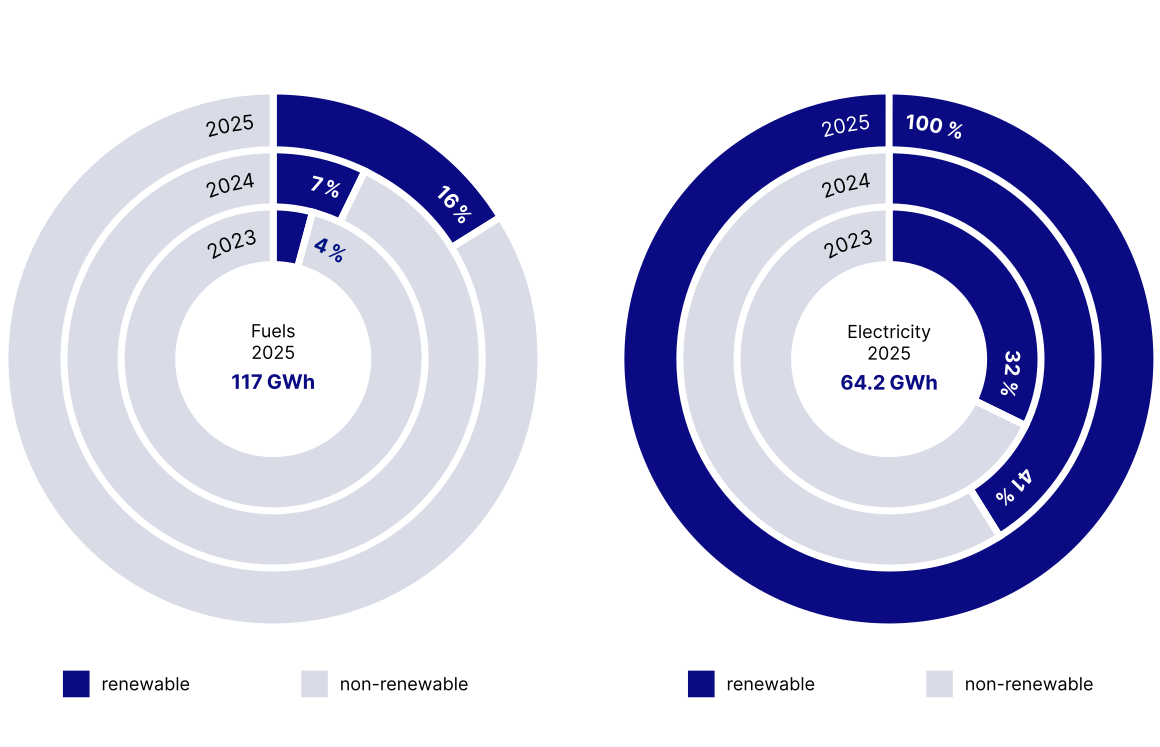
Share of renewable energy at Zurich Airport
Key data
Greenhouse gas emissions
Zurich Airport Group | Unit | 2021 | 2022 | 2023 | 2024 | 2025 | ||||||
CO2e Scope 1 Zurich Airport Group | Tonnes | 32,884 | 30,025 | 24,910 | 25,488 | 23,843 | ||||||
CO2e Scope 2 Zurich Airport Group | Tonnes | 3,001 | 1,342 | 1,286 | 1,187 | 1,235 | ||||||
Total Scope 1 and 2 Group | Tonnes | 35,885 | 31,367 | 26,196 | 26,675 | 25,078 | ||||||
CO2e Scope 3 Group | Tonnes | n/a | n/a | n/a | 4,990,862 | 5,242,784 | ||||||
Zurich Airport Ltd., Zurich Site | Unit | 2021 | 2022 | 2023 | 2024 | 2025 | ||||||
CO2e Scope 1 Zurich Airport Ltd. | Tonnes | 32,372 | 29,043 | 23,992 | 23,843 | 22,513 | ||||||
CO2e Scope 2 Zurich Airport Ltd. | Tonnes | 19 | 24 | 21 | 19 | 28 | ||||||
Total Scope 1 and 2 | Tonnes | 32,390 | 29,067 | 24,014 | 23,861 | 22,540 | ||||||
CO2e Scope 31 | Tonnes | 1,803,913 | 3,471,982 | 4,153,941 | 4,599,9113 | 4,773,132 | ||||||
Florianópolis Airport, Brazil | Unit | 2021 | 2022 | 2023 | 2024 | 2025 | ||||||
CO2e Scope 1 | Tonnes | 1333 | 3843 | 3713 | 2623 | 226 | ||||||
CO2e Scope 2 | Tonnes | 980 | 1463 | 03 | 0 | 0 | ||||||
Total Scopes 1 and 2 | Tonnes | 1,1133 | 5293 | 3713 | 2623 | 226 | ||||||
CO2e Scope 32 | Tonnes | n/a | n/a | n/a | 162,5793 | 187,202 | ||||||
Vitória/Macaé Airports, Brazil | Unit | 2021 | 2022 | 2023 | 2024 | 2025 | ||||||
CO2e Scope 1 | Tonnes | 2703 | 4983 | 3663 | 2223 | 440 | ||||||
CO2e Scope 2 | Tonnes | 1,2003 | 1443 | 03 | 0 | 0 | ||||||
Total Scopes 1 and 2 | Tonnes | 1,4703 | 6423 | 3663 | 2223 | 440 | ||||||
CO2e Scope 32 | Tonnes | n/a | n/a | n/a | 93,3913 | 112,754 | ||||||
Natal Airport, Brazil | Unit | 2021 | 2022 | 2023 | 2024 | 2025 | ||||||
CO2e Scope 1 | Tonnes | n/a | n/a | n/a | 919 | 345 | ||||||
CO2e Scope 2 | Tonnes | n/a | n/a | n/a | 0 | 0 | ||||||
Total Scopes 1 and 2 | Tonnes | n/a | n/a | n/a | 919 | 345 | ||||||
CO2e Scope 32 | Tonnes | n/a | n/a | n/a | 102,5123 | 136,042 | ||||||
Antofagasta Airport, Chile | Unit | 2021 | 2022 | 2023 | 2024 | 2025 | ||||||
CO2e Scope 1 | Tonnes | 10 | 12 | 64 | 70 | 104 | ||||||
CO2e Scope 2 | Tonnes | 452 | 446 | 520 | 474 | 404 | ||||||
Total Scopes 1 and 2 | Tonnes | 462 | 458 | 584 | 544 | 508 | ||||||
CO2e Scope 32 | Tonnes | n/a | n/a | n/a | 20,087 | 21,688 | ||||||
Iquique Airport, Chile | Unit | 2021 | 2022 | 2023 | 2024 | 2025 | ||||||
CO2e Scope 1 | Tonnes | 99 | 57 | 77 | 105 | 104 | ||||||
CO2e Scope 2 | Tonnes | 350 | 541 | 527 | 363 | 439 | ||||||
Total Scopes 1 and 2 | Tonnes | 449 | 598 | 604 | 468 | 543 | ||||||
CO2e Scope 32 | Tonnes | n/a | n/a | n/a | 12,382 | 11,966 | ||||||
Noida Airport, India | Unit | 2021 | 2022 | 2023 | 2024 | 2025 | ||||||
CO2e Scope 1 | Tonnes | n/a | 31 | 40 | 67 | 111 | ||||||
CO2e Scope 2 | Tonnes | n/a | 41 | 218 | 331 | 364 | ||||||
Total Scopes 1 and 2 | Tonnes | n/a | 73 | 258 | 398 | 475 |
Scope 1: In accordance with GHG Protocol: Zurich Airport Ltd.’s own sources (vehicles, machinery, heating).
Scope 2: In accordance with GHG Protocol: externally sourced electricity for Zurich Airport Ltd.
1Under the GHG Protocol, up to and including 2023, aircraft in the LTO cycle and route to the destination, other emission sources at the airport (handling, other heating systems) and all land-side transport from place of departure to destination for all modes of transport; entire value chain according to the GHG Protocol from 2024 onwards.
2Relevant categories of the value chain taken into account in accordance with the GHG Protocol.
3Retroactive correction due to revised data basis.
Sum totals may contain slight discrepancies due to rounding.
Energy
Zurich Airport Ltd., Zurich Site | Unit | 2021 | 2022 | 2023 | 2024 | 2025 | ||||||
Thermal energy | MWh | 120,634 | 106,154 | 103,689 | 107,678 | 111,623 | ||||||
renewable | MWh | 1,584 | 8,886 | 4,292 | 8,094 | 18,999 | ||||||
non-renewable | MWh | 119,050 | 97,268 | 99,397 | 99,584 | 92,625 | ||||||
Fuels | MWh | 4,772 | 4,632 | 5,558 | 4,874 | 5,331 | ||||||
renewable | MWh | 0 | 0 | 0 | 324 | 111 | ||||||
non-renewable | MWh | 4,772 | 4,632 | 5,558 | 4,550 | 5,221 | ||||||
Electricity | MWh | 47,315 | 59,688 | 64,184 | 65,826 | 64,246 | ||||||
renewable | MWh | 14,263 | 16,651 | 20,370 | 27,087 | 64,246 | ||||||
non-renewable | MWh | 33,052 | 43,036 | 43,815 | 38,739 | 0 | ||||||
Total energy consumption (thermal energy, fuel, electricity) | MWh | 172,722 | 170,474 | 173,432 | 178,378 | 181,200 | ||||||
Overall consumption primary energy1 | MWh | 456,589 | 505,205 | 494,359 | 504,238 | 505,167 | ||||||
Energy intensity ratio according to GVV2 | % | 111.2 | 103.9 | 88.8 | 87.9 | 84 | ||||||
Florianópolis Airport, Brazil | Unit | 2021 | 2022 | 2023 | 2024 | 2025 | ||||||
Total fuel consumption | MWh | 252 | 310 | 301 | 390 | 229 | ||||||
Electricity consumption | MWh | 7,716 | 8,423 | 10,654 | 11,111 | 7,621 | ||||||
Total energy consumption | MWh | 7,968 | 8,733 | 10,955 | 11,501 | 7,850 | ||||||
Vitória/Macaé Airports, Brazil | Unit | 2021 | 2022 | 2023 | 2024 | 2025 | ||||||
Total fuel consumption | MWh | 254 | 345 | 403 | 515 | 337 | ||||||
Electricity consumption | MWh | 9,492 | 9,147 | 9,747 | 9,179 | 7,857 | ||||||
Total energy consumption | MWh | 9,746 | 9,492 | 10,150 | 9,694 | 8,194 | ||||||
Natal Airport, Brazil | Unit | 2021 | 2022 | 2023 | 2024 | 2025 | ||||||
Total fuel consumption | MWh | n/a | n/a | n/a | 253 | 292 | ||||||
Electricity consumption | MWh | n/a | n/a | n/a | 12,5363 | 12,173 | ||||||
Total energy consumption | MWh | n/a | n/a | n/a | 12,7893 | 12,465 | ||||||
Antofagasta Airport, Chile | Unit | 2021 | 2022 | 2023 | 2024 | 2025 | ||||||
Total fuel consumption | MWh | 40 | 49 | 46 | 61 | 76 | ||||||
Electricity consumption | MWh | 1,107 | 1,092 | 1,150 | 1,540 | 1,930 | ||||||
Total energy consumption | MWh | 1,147 | 1,141 | 1,196 | 1,601 | 2,006 | ||||||
Iquique Airport, Chile | Unit | 2021 | 2022 | 2023 | 2024 | 2025 | ||||||
Total fuel consumption | MWh | 400 | 231 | 420 | 840 | 960 | ||||||
Electricity consumption | MWh | 856 | 1,323 | 1,290 | 1,451 | 1,450 | ||||||
Total energy consumption | MWh | 1,256 | 1,554 | 1,710 | 2,291 | 2,410 | ||||||
Noida Airport, India | Unit | 2021 | 2022 | 2023 | 2024 | 2025 | ||||||
Total fuel consumption | MWh | n/a | 117 | 152 | 258 | 420 | ||||||
Electricity consumption | MWh | n/a | 51 | 307 | 331 | 508 | ||||||
Total energy consumption | MWh | n/a | 168 | 459 | 589 | 928 |
1Scope total airport excl. fuel.
2Energy consumption measured in terms of energy reference area and user units.
3Retroactive correction.
Sum totals may contain slight discrepancies due to rounding.
