
Remuneration policy at Zurich Airport Ltd.
1. Foundations and principles
At Zurich Airport Ltd., the rules governing remuneration are based on the corporate and capital market law requirements of the Swiss Code of Obligations, the SIX regulations, the company’s Articles of Association (Article 28 ff.) and any resolutions and rules issued on the basis of these Articles. The remuneration policy, reporting and remuneration at Board of Directors and Management Board level are decided on by the Board of Directors or proposed to the Annual General Meeting (AGM).
Overview of decision-making powers
NCC | Board of Directors | Annual General Meeting | ||||
Remuneration policy and remuneration system | proposes | decides | ||||
Remuneration report | proposes | decides | non-binding consultative vote | |||
Maximum total for the members of the Board of Directors | proposes | submits a proposal for approval by the AGM | approves | |||
Remuneration of the members of the Board of Directors in accordance with the remuneration rules | submits a proposal | decides (within the total approved by the AGM) | ||||
Maximum remuneration for members of the Management Board | proposes | submits a proposal for approval by the AGM | approves | |||
Individual remuneration for the members of the Management Board | proposes | decides (within the total approved by the AGM) | ||||
Determination of the annual target values for performance indicators (KPIs) for variable remuneration. | decides |
2. Remuneration philosophy
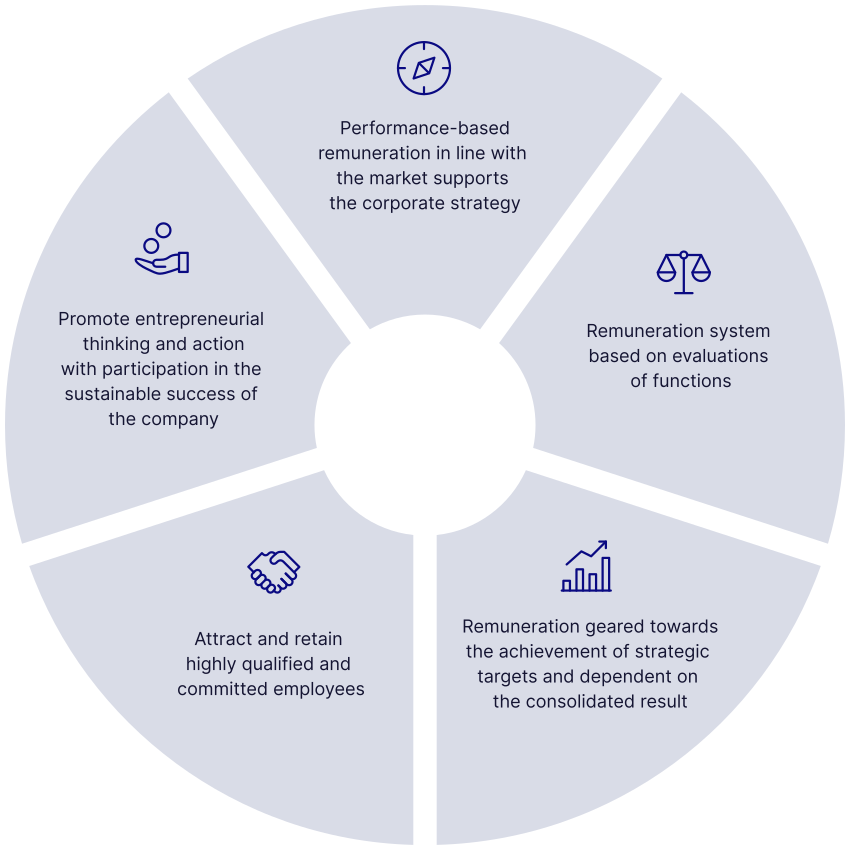
The remuneration philosophy of Zurich Airport Ltd. is based on a corporate strategy geared towards sustainable success. By providing market-based, performance-oriented and success-dependent remuneration, it lays the foundations for attracting and retaining qualified and committed employees in a competitive labour market. The remuneration system is structured in a comprehensible and transparent manner. The remuneration system is based on regular external evaluations of functions such that it remains in line with the market and prevents unequal treatment.
3. Nomination & Compensation Committee (NCC)
Duties of the Nomination & Compensation Committee
The Nomination & Compensation Committee deals with all strategic issues of Human Resource (HR) Management at the company. The Management Board provides regular updates on developments in human resource management. In particular, the NCC deals with HR governance and culture, as well as all issues relating to remuneration, the appointment and dismissal of members of the Management Board, and matters relating to succession planning for the Board of Directors and the Management Board, as well as personnel development at the most senior management levels. It formulates the principles of the company’s personnel and remuneration policy, defines the terms of employment of the Management Board and monitors the achievement of the annual targets set by the Board of Directors.
The Committee also assesses the situation with regard to possible conflicts of interest of members of the Board of Directors or the Management Board and the admissibility of secondary occupations for members of the Management Board.
The NCC reviews the results of the Board of Directors’ annual self-evaluation, considers the feedback from the Management Board and proposes measures to the Board of Directors based on the results of the self-evaluation.
In addition, the NCC monitors the expenses policy and remuneration of the members of the Board of Directors and the remuneration of the Management Board, verifies adherence to the compliance requirements for gifts and hospitality, and is responsible for preparing the remuneration report.
The NCC prepares the necessary resolutions of the Board of Directors and, in principle, assesses the remuneration models annually. If there is any need for an adjustment, the necessary bases for a decision are prepared by the NCC and referred to the Board of Directors along with a proposal.
Composition
The NCC consists of four members. The members of the NCC are elected by the Annual General Meeting from among the members of the Board of Directors for a term of one year.
Members of the NCC in the reporting year
- Claudia Pletscher | Chair
- Guglielmo Brentel
- Vincent Albers | until AGM 2025
- Beat Schwab | from May 2025
- Josef Felder | Chairman of the Board of Directors, without voting rights
Conduct of meetings
In the reporting year, the NCC held seven meetings, which generally lasted two hours. The attendance rate for all NCC members was 100%.
4. Approval by the Annual General Meeting
Each year, the Annual General Meeting holds a binding vote on the aggregate amount of remuneration for the Board of Directors and for the Management Board. On the basis of Article 30 of the company’s Articles of Association, this vote is held prospectively; that is, the maximum aggregate amounts that could be paid to the members of the Board of Directors and the Management Board during the following reporting period are submitted to the Annual General Meeting for approval.
In accordance with Article 30 para. 2 of the Articles of Association, an additional sum of 30% of the approved aggregate amount is available as necessary for the remuneration of any subsequently nominated members of the Management Board (per additional member); this sum does not require the approval of the Annual General Meeting
As the amounts actually to be paid out depend in part on factors not yet known when these amounts are approved (the committees and extraordinary meetings in the case of remuneration of the Board of Directors, the achievement of the financial targets and the qualitative targets in the case of remuneration of the Management Board), this prospective method of approval requires the use of theoretical maximum amounts by the Annual General Meeting as a basis for their approval decisions. The remuneration actually paid out for a specific reporting period will be stated the following year in the remuneration report, which will be presented to the Annual General Meeting for approval on a consultative basis.
Overview of the remuneration paid in 2025 and the approved totals
Total remuneration paid for the 2025 financial year (CHF) | Total approved by the AGM for the 2025 financial year (CHF) | |||
Remuneration of the Board of Directors | 1,699,661 | 1,900,000 | ||
Remuneration of the Management Board | 5,206,515 | 6,500,000 |
5. Remuneration system of the Board of Directors
In order to ensure the independence of the active members of the Board of Directors in the performance of their supervisory duties, their remuneration consists of an annual fixed lump sum. The members of the Board of Directors receive no performance-related remuneration. Annual lump-sum payments are made in respect of their work on the Board of Directors and its committees (which it may form as and when required).
Board Chair1 | Board Vice Chair | Board member | ||||
Board of Directors’ fees | 430,000 | 150,000 | 135,000 |
1No further compensation for participation as a guest in committees and other obligations as Chairman of the Board of Directors.
Chair | Member | |||
Audit & Finance Committee (AFC) | 35,000 | 25,000 | ||
Investment Committee (IC) | 30,000 | 25,000 | ||
Nomination & Compensation Committee (NCC) | 30,000 | 25,000 | ||
Public Affairs Committee (PAC) | 15,000 | 10,000 |
For extraordinary BoD meetings, attendance fees of CHF 1,500 per meeting and participation are paid.
The remuneration model differentiates according to the role of the particular member on the Board of Directors (chair, vice chair, member) and their function on the committees (chair, member), with the additional workload of chairpersons being duly recognised. As before, no flat-rate expenses are paid. Remuneration is paid in cash. Remuneration in the form of shares is dispensed with, as this form is not suitable for the representatives of the Canton and City of Zurich, especially since the shares would be allocated to the canton or city and not to the respective member of the Board of Directors. Changing shareholdings are unsuitable for state entities. The aim is to ensure uniform treatment of the Board of Directors’ fees. Further information on the canton’s delegates can be found in the section entitled Board of Directors.
The remuneration of the Board of Directors is regularly reviewed in line with the market. A benchmark group from the SMIM® (SMI Mid) was defined for review purposes, as Zurich Airport Ltd. is also part of this index. The benchmarked companies included ones with comparable market capitalisation, revenue and employees, but excluded ones from the financial sector for example. The benchmark group for the remuneration model therefore comprises the following companies:
Companies in the benchmark group | ||
Adecco | PSP Swiss Property | |
Avolta | SIG Combibloc | |
Bachem | Swiss Prime Site | |
Barry Callebaut | Tecan | |
Belimo | Temenos | |
Galenica | VAT Group | |
Georg Fischer |
The lump sums applicable to the Board of Directors are based on the median remuneration in the benchmark group. The chair sits on individual committees as a guest, without voting rights and without additional remuneration. The lump-sum fees reflect the working time and the necessary risk management associated with the various committees and individual functions, also with reference to market rates.
An overview of the number of meetings of the Board of Directors and the committees during the reporting year can be found in the section entitled Organisation and participants. The NCC annually reviews the fee model to verify that the chosen criteria continue to be appropriate and are adequately reflected.
6. Remuneration system of the Management Board
Remuneration of members of the Management Board is based on individual employment contracts and comprises a fixed basic salary (basic remuneration and benefits) and a variable performance-related remuneration, plus employer contributions to social security and pension funds.
Remuneration component | Purpose | Structure | Target and maximum amount | Performance measurement | ||||
Basic salary | reflects the function and relevant experience | cash, monthly payment | fixed | |||||
Social security contributions and employee benefits | includes retirement plan and coverage of death and disability risks | pension fund and social security contributions | fixed | |||||
Variable remuneration (short-term and long-term components) | reflects the company’s performance | annual variable remuneration short-term component: Cash payment (2/3) long-term component: Payment in the form of blocked shares with a blocking period of 4 years (1/3) | CEO target: 100% of basic salary Maximum: 150% of basic salary Member of the Management Board target: 50% of basic salary Maximum: 75% of basic salary | financial and qualitative targets: • EBITDA margin • sustainability • customer and passenger satisfaction • recommendation rate/employee satisfaction |
Basic salary
The fixed basic salary is measured in accordance with the company’s remuneration policy. The amounts concerned are set each year by the Board of Directors as proposed by the Nomination & Compensation Committee. The CEO submits a proposal to the NCC concerning the amounts of the respective fixed basic salary of the other members of the Management Board. The members of the Management Board do not have any say in these resolutions of the Board of Directors.
Variable remuneration
Variable remuneration is calculated in accordance with the new arrangement for the reporting year:
The variable remuneration entails the achievement of a financial target with a weighting of two thirds and the achievement of three qualitative targets that have a combined weighting of one third. The financial target and the three qualitative targets are reviewed annually by the Board of Directors within the framework of the given scope for action and, if necessary, adjusted.
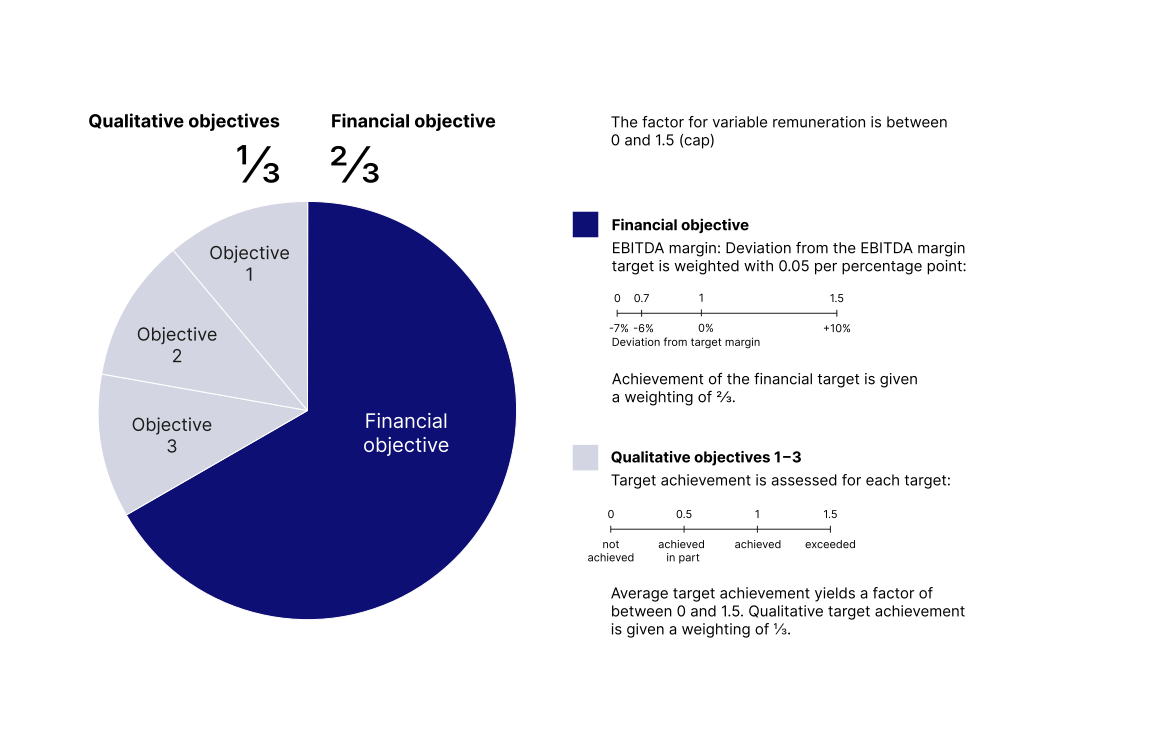
The financial performance indicator corresponds to the EBITDA margin. The qualitative targets for 2025 are aligned to specific key performance indicators pertaining to sustainability, customer and passenger satisfaction as well as the recommendation rate/employee satisfaction.
Payout curve in relation to target EBITDA margin (general concept)
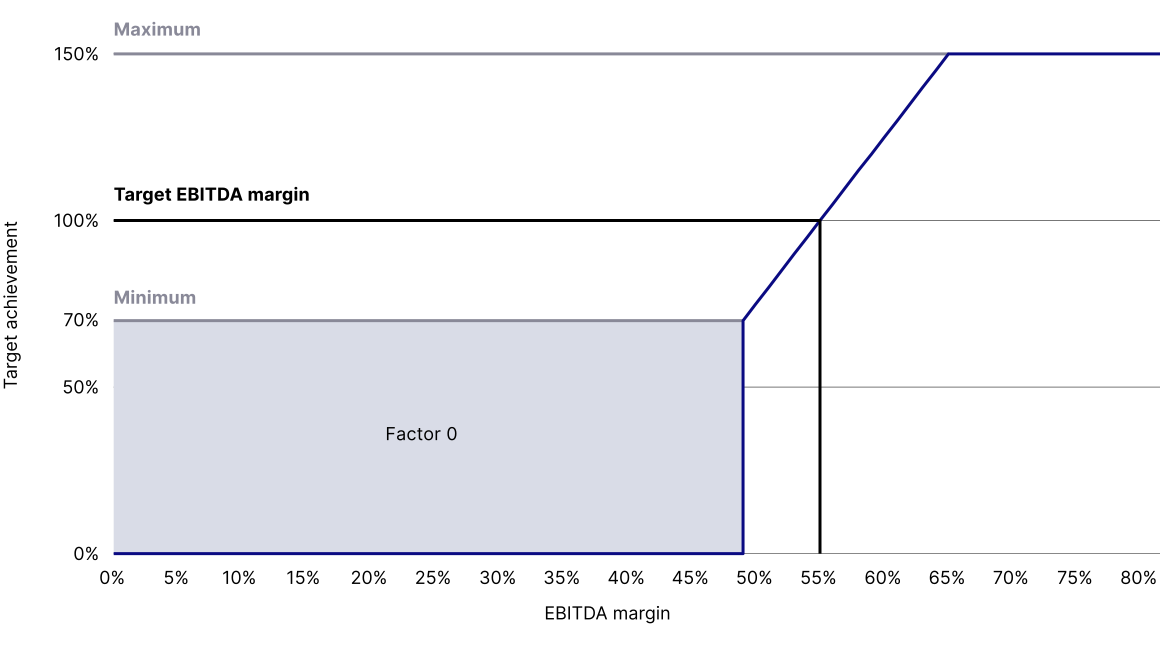
The variable remuneration for full achievement of the targets amounts to 100% of the basic salary for the CEO and 50% of the basic salary for the other members of the Management Board. The variable remuneration is subject to a cap of 150% if the targets are exceeded. If a defined threshold of 70% is not achieved for the EBITDA margin (quantitative target) and for the qualitative targets, no variable remuneration is paid. Within the framework of the provisions of the Articles of Association and regulations, the Board of Directors may grant a variable salary component up to a maximum of a factor of 1.5 of the basic salary.
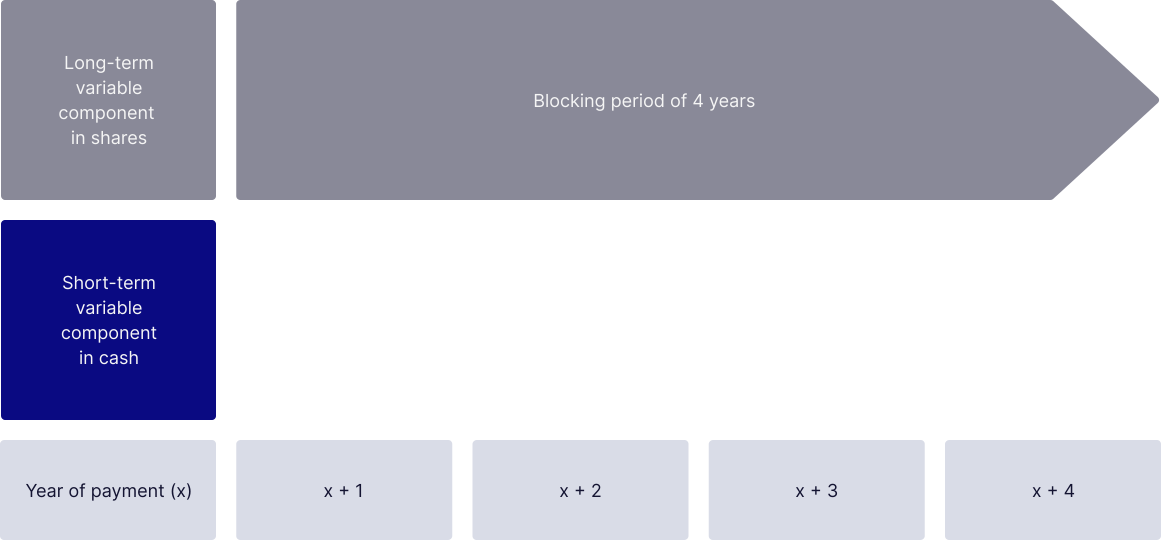
Variable remuneration consists of a short-term and a long-term component: two-thirds is paid out as the short-term component in cash at the end of the financial year, while one-third is paid out as the long-term component in the form of blocked shares. The shares are subject to a four-year blocking period in order to emphasise the focus on the sustainable and long-term success of Zurich Airport Ltd.
Ratio of variable remuneration to basic salary
CEO | Other members of the Management Board | |||
100% target achievement | 100% of basic remuneration | 50% of basic remuneration | ||
Cap | 150% of basic remuneration | 75% of basic remuneration | ||
Financial target achievement < 70% and qualitative targets not achieved | 0% of basic remuneration | 0% of basic remuneration |
The effective value of target achievement is assessed and determined by the Board of Directors.
Pension contributions
The pension contribution system for the Management Board is essentially the same as for other salaried employees based at the Zurich site. The difference is that contributions to the pension fund for the variable salary component of Management Board members are paid in full by the employer. You can find further information on pension planning in the section entitled Responsible employer.
Clawback of variable remuneration (deduction and clawback policy)
In the event of a restatement due to material breaches of applicable accounting rules or in the event of an incorrectly calculated payment of variable remuneration, the Board of Directors may recalculate the variable remuneration and reduce outstanding entitlements to the variable remuneration (deduction) or request the members of the Management Board to reimburse some or all of the amounts already paid out (clawback). In addition, the Board of Directors may reduce the variable remuneration or reclaim it for up to three years in the event of intentional, serious breaches of duty by members of the Management Board that are detrimental to the company and result in disciplinary consequences or termination of employment.
Shareholding rules
Each member of the Management Board is obliged to hold shares in the amount of at least 200% of the basic salary (CEO) or at least 100% for the other members of the Management Board within five years of taking office. The shareholding rules were introduced in the reporting year. The deadline for acquiring the shares is five years from the time it enters into effect. The NCC reviews compliance with the shareholding rules annually.
