
Biodiversity
Natural spaces are under pressure in inhabited areas. The expansive green areas at airports contribute to habitat and species diversity. Zurich Airport Ltd. takes compensatory measures if ecologically valuable land is used.
Relevance
Species and habitat diversity is under pressure around the world. Most of the Zurich Airport Group’s sites are located adjacent to sensitive ecosystems. Accordingly, the company bears a responsibility to preserve the existing habitats and the biodiversity found there. Priorities are set differently depending on the initial situation. What they all have in common is the intention to operate the airports with minimal negative impact on flora and fauna while implementing projects to promote ecological diversity. All sites also have a legal obligation to use other means to compensate for unavoidable interference with the biosphere.
As well as safety and operational considerations, international regulations also include specific requirements or recommendations concerning the maintenance and conservation of green areas on airport grounds. Together with nature conservation stipulations in local legislation, these form the framework for how the Zurich Airport Group manages green areas.
As the airport at the Zurich site was originally built in the middle of reed meadows, its perimeter still encompasses extensive areas that are of especially high ecological value. Around half of the 953-hectare area covered by the SAIP perimeter (perimeter as specified by the Sectoral Aviation Infrastructure Plan, Zurich Airport detailed plan (Objektblatt)) comprises meadows and forest. Thanks to the airport fence, a mosaic of different habitats provides animals and plants – in some cases rare ones – with a home where they can be largely undisturbed. A total of 74 hectares are designated nature conservation areas, including low moorlands of national importance. The company aims to preserve these habitats within the airport perimeter, especially since they are of a nature and quality that has become something of a rarity elsewhere in the central plateau.
In Brazil, too, the Zurich Airport Group’s airports are adjacent to sensitive ecosystems, such as coastlines (Florianópolis, Vitória and Macaé) and a rainforest (Natal). In Noida, India, agricultural areas that were home to protected species were used for the construction of the new airport. At the two sites in Chile, the airport grounds along with their development and maintenance are the exclusive responsibility of the authorities.
Approach
At its Zurich site, Zurich Airport Ltd. is doing everything necessary to preserve the ecological value of the protected areas within the airport perimeter and to meet the associated conservation goals defined by the authorities. The protected areas include various marshland and forest habitats. Cultivation of extensive tracts of the remaining airport grounds as high-grass meadows is in fact in the interests of both airfield operations and nature conservation (see Bird strikes). As nutrient-poor environments, the high-grass meadows are rich in biodiversity. Various measures to promote individual species and create specific habitats were continued in the reporting year.
When Zurich Airport Ltd. plans to build on green areas, the ecological value of these areas is measured using recognised methods. As part of the subsequent construction project, the company is then legally obliged to offset this impact by implementing compensatory measures of equal value elsewhere. It aims to create areas with high-quality habitats appropriate to the location wherever possible, for example ones considered a priority by the federal government.
The largest project of this kind currently in progress is the upgrading of the Glatt, the river to the west of the airport, with which Zurich Airport Ltd. is offsetting several construction projects (see project website). This major revitalisation project is divided into four phases. Covering most of the stretch of river, the three southern sections – between Opfikon and Rümlang – are being implemented by Zurich Airport Ltd. The company considers it extremely important that the project’s implementation offers long-term ecological value. It is going to great lengths to create the planned habitats, for example by collecting seeds from 220 species in nature reserves throughout Glatttal for sowing at the new site or rearing seedlings for later planting. Extensive archaeological probes were also necessary, as the perimeter of the construction site is adjacent to an archaeological zone. Construction work on the first section began in April of the reporting year. The channel’s design and the implementation of deadwood structures in the water were further optimised along a pilot stretch of the river. The first section will be completed in 2026.
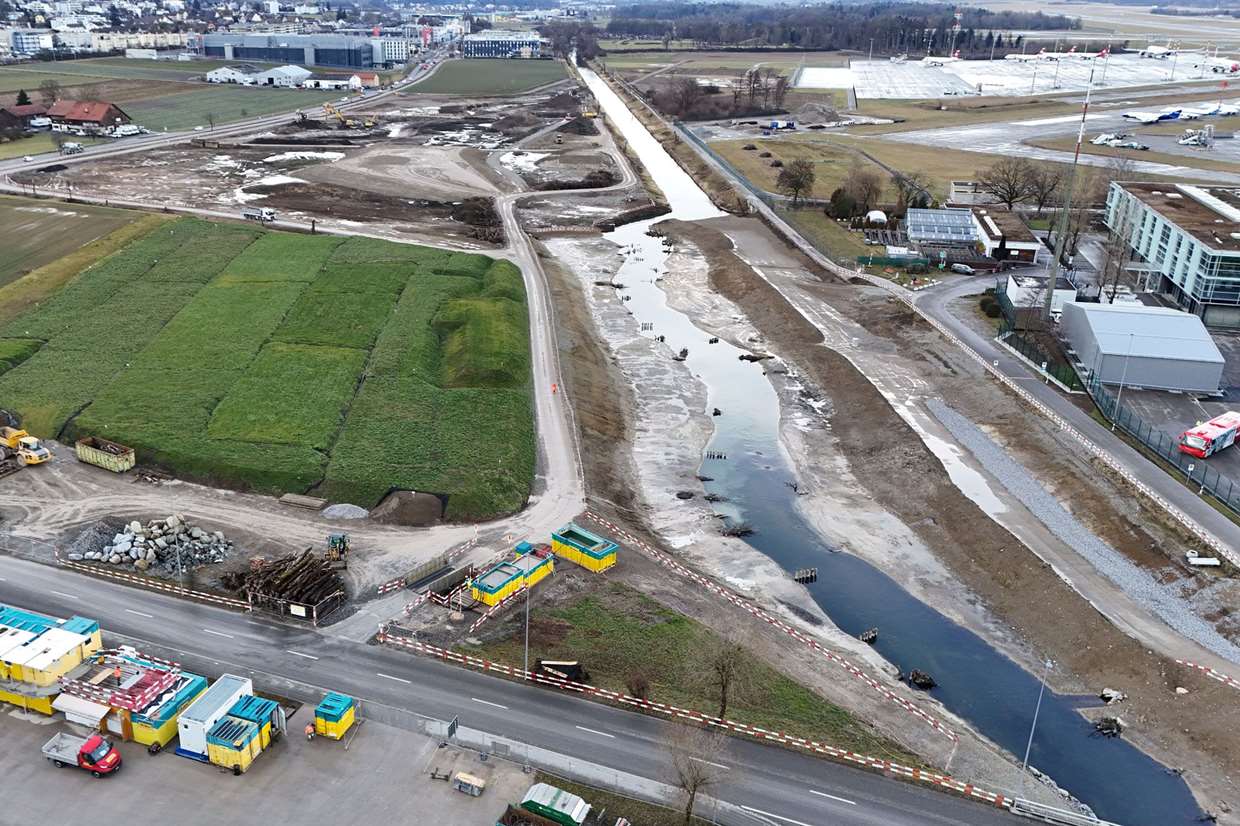
In the foreground, the completed Eichhof section of the Glatt revitalisation project; in the background, the current construction site for the next section.
Targeted sampling along the perimeter of the revitalisation project revealed that the soil is contaminated by PFAS (per- and polyfluoroalkyl substances). How PFAS-contaminated soil is to be dealt with is currently an unanswered legal question. As a result, it is not clear when the implementation of the remaining sections can be started (see project website). PFAS have been used in a wide variety of applications and products since the 1970s. These substances end up in the environment in a variety of ways, where they hardly break down. The areas affected by the Glatt revitalisation project are outside the airport perimeter. The pollution in the ground has no demonstrable link to the airport or flight operations.
Preserving biodiversity and the ecological value of green areas at airports is also an important issue in Brazil. The airports in Florianópolis and Vitória were awarded the “Green Airport Recognition” prize for the second time in the reporting year for projects related to wildlife conservation.
At the site in Noida, India, it was inevitable that some parts of existing habitats would be lost when constructing the airport on land that had mainly been used as arable land in the past. From the outset, a special focus was placed on preserving the biosphere, for example through tree transplantations, measures to protect existing trees and the planting of thousands of new trees from the company’s own nursery. In addition, various measures have been taken to preserve the nutrient-rich topsoil as a valuable resource.
Bird strikes
With their extensive open spaces and forests, shrubs and bodies of water, airports attract many species of bird. However, large birds and flocking birds in particular can present a safety risk for aircraft. Collisions between birds and aircraft (known as bird strikes) can have very serious consequences and so must be avoided at all costs. Measures are therefore being taken at all sites to make the airport grounds less attractive to birds and thereby reduce the risk of collisions.
One tactic is to cultivate most of the open areas as extensive high-grass meadows; this is the approach being taken in Zurich and at the sites in Brazil. It is both environmentally friendly and also helps to prevent bird strikes as the high grass makes it difficult for birds of prey to spot their prey on the ground. It also discourages flocking birds from settling there. Further steps are aimed at reducing the birds’ food supply at the sites – for instance weasels especially are encouraged because they compete with birds of prey in hunting mice. In Brazil, falcons are used at the Florianópolis and Vitória sites as a gentle way of scaring off individual birds.
