Focus
Sustainability enshrines the long-term orientation of business activities and high standards of corporate, environmental and social responsibility in the corporate strategy.
Zurich Airport Ltd. is a listed, semi-public company that owns and operates Zurich Airport, Switzerland’s most important international transport and meeting hub. It focuses on its core tasks in its role as airport operator, in the management of commercial centers and in the management and further development of the properties and infrastructure at the Zurich site. These three roles also shape the majority and minority stakes that it additionally holds in foreign airports, with division of responsibility varying from site to site. Its portfolio includes the airports in Florianópolis, Natal, Vitória and Macaé in Brazil, Iquique and Antofagasta (until 28 February 2026) in Chile and Noida in India, which are fully owned, as well as minority interests in the Belo Horizonte and Curaçao sites. These majority interests abroad and the Zurich site are collectively referred to in this report as the “Zurich Airport Group”.
This report complies with the standards of the Global Reporting Initiative (GRI) and provides information on the company’s impacts on the environment and society. It covers the Zurich site and all other sites with majority interests, but does not include minority interests and management contracts (see Group locations). The report shows both the positive and negative impacts of the Group’s business activities at its various sites and what action Zurich Airport Ltd. is taking to mitigate adverse impacts and enhance positive effects along its value chain. It also reports on the impact of climate change on business activities. A reference to the requirements of the GRI Standards can be found in the right-hand margin.
This section presents the company’s non-financial reporting in accordance with Article 964a et seq. of the Swiss Code of Obligations and provides an account of the relevant environmental, social, workforce, human rights and anti-corruption matters. It includes climate-related matters as well as their opportunities and risks. To read more about the other risks to the company, please refer to the supplemental general information in the sections entitled Corporate profile and Risk management.
Guidelines and their implementation in the company
Zurich Airport Ltd. aligns its sustainable business activities with the ten principles on human rights, labour standards, the environment and anti-corruption contained in the United Nations Global Compact (UNGC), of which it has been a signatory since 2021. It undertakes to comply with the principles throughout the Group and has set out specific requirements in the Group Code of Conduct, which is binding for all companies with a majority interest. It is available in German, English, Portuguese and Spanish and is an integral part of the employment contract for all employees. Violations of the Code of Conduct will lead to disciplinary consequences. The majority interests have based their own additional codes of conduct on the Group Code of Conduct as a minimum requirement.
The Code of Conduct sets out minimum requirements for conduct and reporting on non-financial topics, as set out in this report. It makes reference to human rights as enshrined in the Universal Declaration of Human Rights of the United Nations (UN), as well as to the UN Guiding Principles on Business and Human Rights, the Core Labour Standards No. 138 and 182 of the International Labour Organisation (ILO) and the ILO Child Labour Guidance Tool for Business, with which the Zurich Airport Group complies. The company also has numerous additional guidelines on specific topics. At the Zurich site, for instance, there are guidelines on sustainability, environmental protection in general, climate protection and fair treatment of employees, as well as on security and occupational safety. See the respective individual sections on each topic for further information. Environmental issues are addressed at the Zurich site using an environmental management system that is certified in accordance with the international standard ISO 14001:2015. Certification has been in place since 2001 and is audited by a third party each year. At the airport in Noida, the construction project is likewise certified in accordance with ISO 14001:2015.
With the Business Partner Code of Conduct, the Zurich Airport Group also places obligations on companies with which Zurich Airport Ltd. maintains a business relationship, in particular suppliers and concessionaires, with respect to social, environmental and ethical standards.
Ultimate oversight of responsible corporate governance and compliance with the ten principles of the UNGC and the Code of Conduct lies with the Board of Directors of Zurich Airport Ltd. The Management Board and thus the heads of divisions are responsible for implementing the sustainability strategy. They all have the same responsibility to ensure that the principles and policies of the company are adhered to. In the reporting year, responsibility for coordinating and developing the topic of sustainability was transferred from the head of the Finance & Services division to the head of the People & Communications division. The former Sustainability & Environment department was also integrated into this division and is now called Sustainability & Public Affairs. Its department head chairs the ESG Steering Committee, which is composed of the heads of Finance & Services and People & Communications as well as representatives of the Legal & Compliance, Financial Services, International Business and Sustainability & Public Affairs departments (for current information, see Organisational structure). The committee coordinates the implementation of the strategic approach to sustainability and the preparation of this non-financial report in close collaboration with the relevant specialist departments of the line organisation. Non-financial reporting is supervised by the Board of Directors through the “Audit & Finance Committee”. Overall supervision of non-financial reporting lies with the full Board of Directors.
Strategic approach
The Zurich Airport Group strives to be one of the leading airport operators in the area of sustainability. Its strategic approach focuses on the topics of regional contribution, noise, climate, occupational and aviation safety, and business ethics, as shown in the graphic below. The Aviation, Commercial, Real Estate and International business divisions must meet their own ESG targets. Further details can be found in the section entitled Purpose, strategy and values.
The valid goal for all sites is to achieve net-zero greenhouse gas emissions in Scope 1 and 2 without offsetting by 2040 at the latest. At Noida Airport in India, the company is already aiming to achieve net zero emissions by 2030. In addition, the various sites have adapted their targets for the most important sustainability topics to the respective circumstances. The sites in Latin America and those in India each have an ESG Committee that manages sustainability activities at a strategic level.
The graphic below provides an overview of the five material topics and ambitions of the Zurich Airport Group. The circular diagram illustrates the fact that the topics can only represent responsible corporate governance in concert and mutual complementarity. Corporate governance forms the foundation of this and is therefore depicted in the center of the graphic.
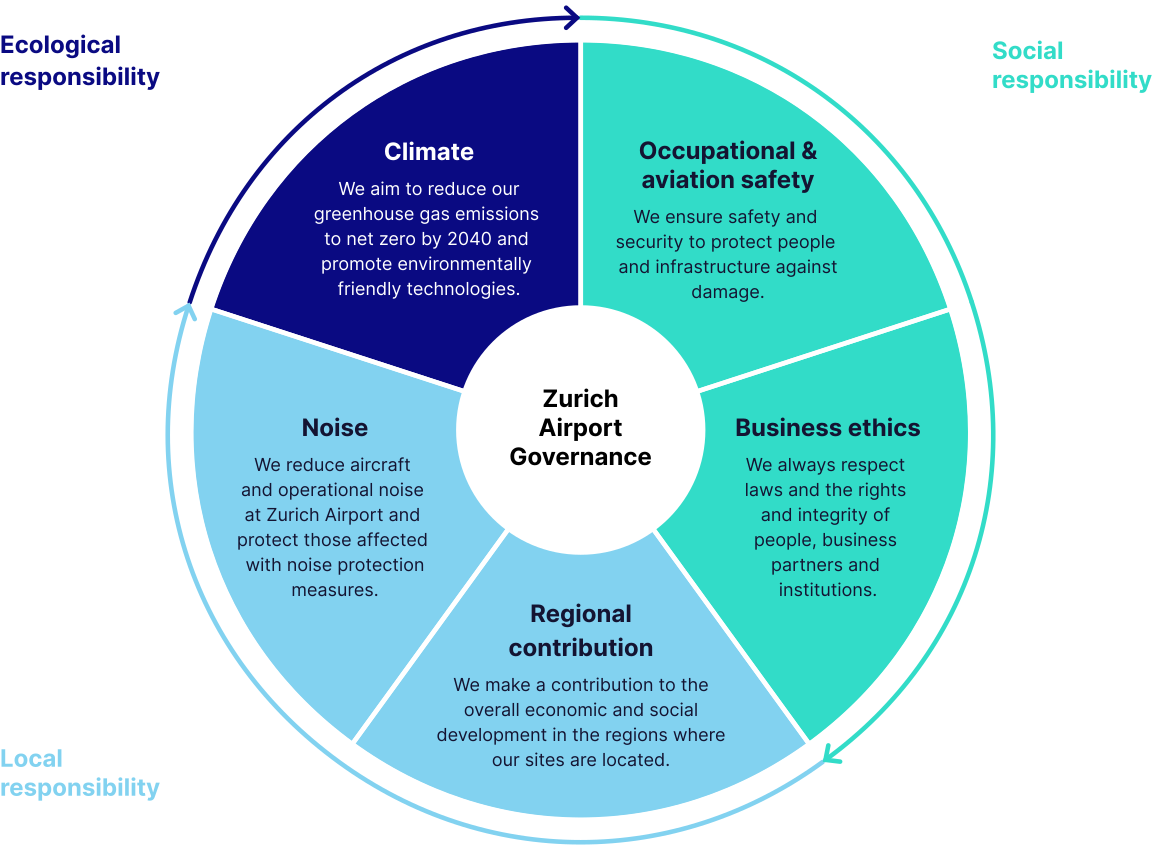
Sustainability ambitions of the Zurich Airport Group
Awards
In the reporting year, Zurich Airport was recognised by the Airports Council International for its commitment to other airports as part of the Airport Excellence Program (APEX), with one award received on the topic of environmental protection and a second award for safety. As part of the programme, experts from Zurich Airport Ltd. conducted peer reviews to support other airports.
Airports belonging to the Zurich Airport Group also received awards in Brazil. The “Aeroportos Sustentáveis” sustainability award, conferred by the Brazilian aviation authority, went to Florianópolis for the fourth time in a row in the category of up to 5 million passengers; second place went to Vitória Airport and third to Natal Airport. All three airports occupy these positions in all three awarded segments (“Emissions and Noise”, “Resources” and “Society”). Macaé likewise took first place in the category of airports with up to half a million passengers in the “Emissions and Noise” segment. Florianópolis and Vitória Airports have also been awarded a Green Recognition Award by the Latin American airport association for projects in the field of biodiversity.